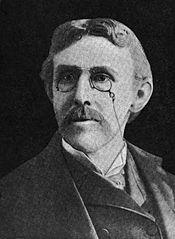
“When Spring is old, and dewy windsBlow from the south, with odors sweet,I see my love, in shadowy groves,Speed down dark aisles on shining feet.”
Quote by Maurice Thompson
“A state too expensive in itself, or by virtue of its dependencies, ultimately falls into decay; its free government is transformed into a tyranny; it disregards the principles which it should preserve, and finally degenerates into despotism. The distinguishing characteristic of small republics is stability: the character of large republics is mutability.”
“The three greatest fools (majaderos) of history have been Jesus Christ, Don Quixote - and I!”
“With regard to Banks, they have taken too deep and too wide a root in social transactions, to be got rid of altogether, if that were desirable. They have a hold on public opinion, which alone would make it expedient to aim rather at the improvement, than the suppression of them. As now generally constituted, their advantages whatever they be, are outweighed by the excesses of their paper emissions, and the partialities and corruption with which they are administered.”
“May it not be asked of every intelligent friend to the liberties of his country, whether the power exercised in such an act as this ought not to produce great and universal alarm? Whether a rigid execution of such an act, in time past, would not have repressed that information and communication among the people which is indispensable to the just exercise of their electoral rights? And whether such an act, if made perpetual, and enforced with rigor, would not, in time to come, either destroy our free system of government, or prepare a convulsion that might prove equally fatal to it?”
Source: The Debates in the Several State Conventions on the Adoption of the Federal Constitution: As Recommended by the General Convention at Philadelphia in 1787. Together with the Journal of the Federal Convention, Luther Martin's Letter, Yates's Minutes, Congressional Opinions, Virginia and Kentucky Resolutions of '98-'99, and Other Illustrations of the Constitution
“[T]he powers granted by the proposed Constitution are the gift of the people, and may be resumed by them when perverted to their oppression, and every power not granted thereby remains with the people.”
Source: The Writings of James Madison: 1787-1790
“[In the case of] dangerous exercise of other powers, not granted by the said compact, the states, who are parties thereto, have the right, and are duty bound, to interpose for arresting the progress of the evil.”
Source: The Debates in the Several State Conventions on the Adoption of the Federal Constitution: As Recommended by the General Convention at Philadelphia in 1787. Together with the Journal of the Federal Convention, Luther Martin's Letter, Yates's Minutes, Congressional Opinions, Virginia and Kentucky Resolutions of '98-'99, and Other Illustrations of the Constitution
“I have sometimes thought there could be no stronger testimony in favor of Religion or against temporal Enjoyments even the most rational and manly than for men who occupy the most honorable and gainful departments and are rising in reputation and wealth, publicly to declare their unsatisfactoriness by becoming fervent Advocates in the cause of Christ, & I wish you may give in your Evidence in this way. Such instances have seldom occurred, therefore they would be more striking and would be instead of a "Cloud of Witnesses.”
Source: The Papers of James Madison
“Resolved, That the General Assembly of Virginia, doth unequivocally express a firm resolution to maintain and defend the Constitution of the United States, and the Constitution of this State, against every aggression either foreign or domestic, and that they will support the Government of the United States in all measures warranted by the former.”
Source: Selected Writings of James Madison
“In a free Government, the security for civil rights must be the same as that for religious rights. It consists in the one case in the multiplicity of interests, and in the other in the multiplicity of sects. The degree of security in both cases, will depend on the number of interests and sects; and this may be presumed to depend on the extent of country and number of People comprehended under the same Government.”
Source: The Federalist
“Congress shall never disarm any citizen unless such as are or have been in actual rebellion.”
Source: The Debates in the Federal Convention of 1787: Which Framed the Constitution of the United States of America