Quotessence
Home / Quotes / Quote by William Faulkner

Quote by William Faulkner

Work

As I Lay Dying

William Faulkner's 'As I Lay Dying' is a narrative told from multiple perspectives, focusing on the Bundren family's journey to bury their mother in a distant town. The novel delves into themes of identity, fate, and the American South, showcasing Faulkner's distinctive prose style and his exploration of the human condition. more
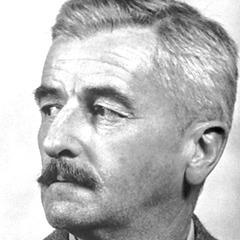
Author

William Faulkner
William Faulkner

William Faulkner, an American writer born on September 25, 1897, and died on July 6, 1962. Known for his unique narrative techniques and profound descriptions of Southern society and history, Faulkner is considered one of the great novelists of the 20th century. more

You May Also Like

“It is a difficult question, my friends, for any young man-- that question I had to grapple with, and which thousands are weighing at the present moment in these uprising times-- whether to follow uncritically the track he finds himself in, without considering his aptness for it, or to consider what his aptness or bent may be, and re-shape his course accordingly. I tried to do the latter, and I failed. But I don't admit that my failure proved my view to be a wrong one, or that my success would have made it a right one; though that's how we appraise such attempts nowadays--I mean, not by their essential soundness, but by their accidental outcomes. If I had ended by becoming like one of these gentlemen in red and black that we saw dropping in here by now, everybody would have said: 'See how wise that young man was, to follow the bent of his nature!' But having ended no better than I began they say: 'See what a fool that fellow was in following a freak of his fancy!”

“But are his needs any more shocking than the needs of any other animals and men? Are his deeds more outrageous than the deeds of the parent who drained the spirit from his child? The vampire may foster quickened heartbeats and levitated hair. But is he worse than the parent who gave to society a neurotic child who became a politician? Is he worse than the manufacturer who set up belated foundations with the money he made by handing bombs and guns to suicidal nationalists? Is he worse than the distiller who gave bastardized grain juice to stultify further the brains of those who, sober, were incapable of progressive thought? (Nay, I apologize for this calumny; I nip the brew that feeds me.) Is he worse, then, than the publisher who filled ubiquitous racks with lust and death wishes? Really, no, search your soul, lovie--is the vampire so bad?”

“And no matter how much the gray people in power despise knowledge, they can’t do anything about historical objectivity; they can slow it down, but they can’t stop it. Despising and fearing knowledge, they will nonetheless inevitably decide to promote it in order to survive. Sooner or later they will be forced to allow universities and scientific societies, to create research centers, observatories, and laboratories, and thus to create a cadre of people of thought and knowledge: people who are completely beyond their control, people with a completely different psychology and with completely different needs. And these people cannot exist and certainly cannot function in the former atmosphere of low self-interest, banal preoccupations, dull self-satisfaction, and purely carnal needs. They need a new atmosphere— an atmosphere of comprehensive and inclusive learning, permeated with creative tension; they need writers, artists, composers— and the gray people in power are forced to make this concession too. The obstinate ones will be swept aside by their more cunning opponents in the struggle for power, but those who make this concession are, inevitably and paradoxically, digging their own graves against their will. For fatal to the ignorant egoists and fanatics is the growth of a full range of culture in the people— from research in the natural sciences to the ability to marvel at great music. And then comes the associated process of the broad intellectualization of society: an era in which grayness fights its last battles with a brutality that takes humanity back to the middle ages, loses these battles, and forever disappears as an actual force.”

“[They] may have for instance taken the view of Edmund Burke, who in the 18th century made the central conservative insight; that a culture and a society are not things run for the convenience of the people who happen to be here right now, but is a deep pact between the dead, the living, and those yet to be born.”