Quotessence
Home / Quotes / Quote by Friedrich Nietzsche

Quote by Friedrich Nietzsche

Author

Friedrich Nietzsche
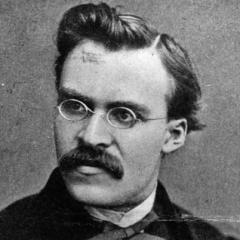
Friedrich Nietzsche

Friedrich Nietzsche was a German philosopher, cultural critic, poet, and writer whose works have had a profound impact on subsequent philosophy, literature, and thought. His ideas revolve around concepts such as the 'will to power', the 'Übermensch', and the 'eternal recurrence'. more

You May Also Like

“Nothing seems to me to be rarer today then genuine hypocrisy. I greatly suspect that this plant finds the mild atmosphere of our culture unendurable. Hypocrisy has its place in the ages of strong belief: in which even when one is compelled to exhibit a different belief one does not abandon the belief one already has.”

“It is only by fidelity in little things that the grace of true love to God can be sustained, and distinguished from a passing fervor of spirit. . . . No one can well believe that our piety is sincere, when our behavior is lax and irregular in its little details. What probability is there that we should not hesitate to make the greatest sacrifices, when we shrink from the smallest?”

“Every schoolchild knows that Columbus set out across the sea to prove that the world was round. But the belief in a spherical earth had a long and illustrious pedigree, as Columbus himself was well aware. . . . "The second reason that inspired the Admiral [Columbus] to launch his enterprise and helped justify his giving the name 'Indies' to the lands which he discovered was the authority of many learned men who said that one could sail westward from the western end of Africa and Spain to the eastern end of India, and that no great sea lay between."”

“Of all the spirits, I believe the spirit of judging is the worst, and it has had the rule of me, I cannot tell you how dreadfully and how long. . . . This, I find has more hindered my progress in love and gentleness than all things else. I never knew what the words, "Judge not that ye be not judged," meant before; now they seem to me some of the most awful, necessary, and beautiful in the whole Word of God.”

“However much we talk of the inexorable laws governing the life of individuals and of societies, we remain at the bottom convinced that in human affairs everything in more or less fortuitous. We do not even believe in the inevitability of our own death. Hence the difficulty of deciphering the present, of detecting the seeds of things to come as they germinate before our eyes. We are not attuned to seeing the inevitable.”