Quotessence
Home / Quotes / Quote by Friedrich Engels

Quote by Friedrich Engels

“We find two great gangs of political speculators, who alternately take possession of the state power and exploit it by the most corrupt ends -- the nation is powerless against these two great cartels of politicians who are ostensibly its servants, but in reality dominate and plunder it.”

Quote by Friedrich Engels

Work

Basic writings on politics and philosophy

This book compiles essential readings that delve into the core concepts and theories of politics and philosophy, offering insights into historical and contemporary perspectives on governance, ethics, and societal structures. more

Author
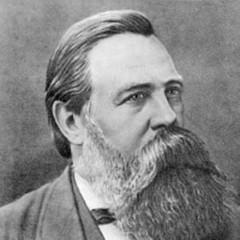
Friedrich Engels
Friedrich Engels

Friedrich Engels was a German philosopher, politician, economist, and revolutionary, co-founder of communist theory with Karl Marx. He was born on November 28, 1820, and died on August 5, 1895. more

You May Also Like

“The slave frees himself when, of all the relations of private property, he abolishes only the relation of slavery and thereby becomes a proletarian; the proletarian can free himself only by abolishing private property in general.”

“We discovered that in connection with these figures the German national simpletons and money-grubbers of the Frankfurt parliamentary swamp always counted as Germans the Polish Jews as well, although this dirtiest of all races, neither by its jargon nor by its descent, but at most only through its lust for profit, could have any relation of kinship with Frankfurt.”

“Thus at every step we are reminded that we by no means rule over nature like a conqueror over a foreign people, like someone standing outside nature - but that we, with flesh, blood and brain, belong to nature, and exist in its midst, and that all our mastery of it consists in the fact that we have the advantage over all other creatures of being able to learn its laws and apply them correctly.”

“The first act by virtue of which the State really constitutes itself the representative of the whole of societythe taking possession of the means of production in the name of societythis is, at the same time, its last independent act as a State. State interference in social relations becomes, in one domain after another, superfluous, and then dies out of itself; the government of persons is replaced by the administration of things, and by the conduct of processes of production. The State is not abolished. It dies out.”