Quotessence
Home / Quotes / Quote by T. S. Eliot

Quote by T. S. Eliot

Work

The Poems of T. S. Eliot Volume I: Collected and Uncollected Poems

This volume presents a curated selection of T. S. Eliot's poems, showcasing his literary contributions across various stages of his career. It includes classic works alongside lesser-known pieces, offering readers a deep dive into the poet's creative output. more

Author
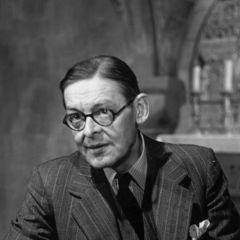
T. S. Eliot
T. S. Eliot

T. S. Eliot, a British playwright and poet, was born on September 26, 1888, in St. Louis, Missouri, USA, and died on January 4, 1965, in London, England. His works are known for their profound philosophical thoughts and unique poetic style, making him one of the most important literary figures of the 20th century. more

You May Also Like

“In Japan we have the phrase, "Shoshin," which means "beginner's mind." Our "original mind" includes everything within itself. It is always rich and sufficient within itself. This does not mean a closed mind, but actually an empty mind and a ready mind. If your mind is empty, it is always ready for anything. It is open to everything. In the beginner's mind there are many possibilities; in the expert's mind there are few.”

“We put thirty spokes to make a wheel: But it is on the hole in the center that the use of the cart hinges. We make a vessel from a lump of clay; But it is the empty space within the vessel that makes it useful. We make doors and windows for a room; But it is the empty spaces that make the room livable. Thus, while existence has advantages, It is the emptiness that makes it useful.”

“'THIS ROOM HAS MYSTERY LIKE A TRANCE' This room has mystery like a trance Of wine ; forget-me-nots of you Are chair and couch, the books your Fingers touched. And now that you Are absent here the silence scrapes A secret rust from everything; While sudden wreaths of sorrow's Dust uncover emptiness like halls To stumble through, and terror falls”

“The mind remains undetermined in the great Void. Here the highest knowledge is unbounded. That which gives things their thusness cannot be delimited by things. So when we speak of 'limits', we remain confined to limited things. The limit of the unlimited is called 'fullness.' The limitlessness of the limited is called 'emptiness.' Tao is the source of both. But it is itself neither fullness nor emptiness”

“The Savior desires to save us from our inadequacies as well as our sins. Inadequacy is not the same as being sinful - we have far more control over the choice to sin than we may have over our innate capacity. . . . A sense of falling short or falling down is not only natural but essential to the mortal experience. Still, after all we can do, the Atonement can fill that which is empty, straighten our bent parts, and make strong that which is weak.”

“The best leaders are those their people hardly know exist. The next best is a leader who is loved and praised. Next comes the one who is feared. The worst one is the leader that is despised ... The best leaders value their words, and use them sparingly. When they have accomplished their task, the people say, "Amazing! We did it, all by ourselves!”