Quotessence
Home / Quotes / Quote by Friedrich Nietzsche

Quote by Friedrich Nietzsche

“This is how I want man and woman: fit for war the one, fit for bearing children the other, but both fit to dance in head and limb. And let each day be a loss to us on which we did not dance once! And let each truth be false to us which was not greeted by one laugh! --------------------------------------------Thus Spoke Zarathustra, chapter 56 (Old and new tables), number 23”

Quote by Friedrich Nietzsche

Work

Thus spake Zarathustra

Thus Spoke Zarathustra is a philosophical novel by the German philosopher Friedrich Nietzsche, first published in 1883. The book is a collection of discourses attributed to Zarathustra, a fictional prophet-like figure who has returned to Earth after a long period of solitude in the mountains. The novel delves into themes such as the eternal recurrence of the same events, the creation of the overman, and the will to power. It is considered one of Nietzsche's most influential works and a cornerstone of modern Western philosophy. more

Author
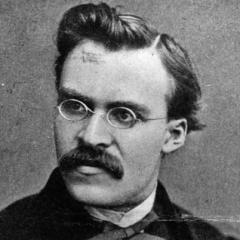
Friedrich Nietzsche
Friedrich Nietzsche

Friedrich Nietzsche was a German philosopher, cultural critic, poet, and writer whose works have had a profound impact on subsequent philosophy, literature, and thought. His ideas revolve around concepts such as the 'will to power', the 'Übermensch', and the 'eternal recurrence'. more

You May Also Like

“Do you have a copy of "these" books or "its just Stellah talking?"...."Get out of my way, says the Lord God Almighty to Anointed Author Stellah Mupanduki of Jesus Christ concerning the Works/Books of healing breathed by the Holy Spirit of a Sovereign God" ...Yeah...Click bio link for more book source links or go for other online bookstores carrying the work of her/my hands.”

“Sometimes it comes down to a choice," Magnus said. "Between saving one person and saving the whole world. I've seen it happen, and I'm selfish enough to want the person who loves me to choose me. But Nephilim wil always choose the world. I look at Alec and I feel like Lucifer in Paradise Lost. 'Abashed the Devil stood, And felt how awful goodness is.' He meant it in the classical sense. 'Awful' as in inspiring awe. And awe is well and good, but it's poison to love. Love has to be between equals." "He's just a boy," said Luke. "Alec--he's not perfect. And you're not fallen." "We're all fallen," said Magnus, and he wrapped himself up in his chains and was silent.”

“Images such as these familiar ones (I mean to suggest) build up an imaginary country in which the story becomes credible; we recognize it as the particular country of our imagination where people would act as they do in the story, would do the deed they do. And the largeness of the images makes it a country wide enough so that the victim could escape, if he chose; like Achilles. But it is the rhythmic power of the dancing, of the dance scenes, that turns the pantomime quality of a gesture into an emblem, into an image with all its own country all around it.”

“She was faint by passing the terrible things art has done countless times over, why believe in put down theories and books her eyes constantly told me without lower lengths of ultraviolet new beams pouring from an endless waterfall toward the center of every center. I've emerged my skin in years of Roman romance only to find cosmic rays from a different perspective and on that note perception expanded all the truthful parts of myself. I was merely deadly alone in a sunlit gaze trying to hold my organs inside long enough to finish the next book, to wrap the defensive cloak of life before the moon rose from the red sea eons ago, casting the net of creation where no man has ever been.”

“Exiles, she and Leroy. They didn't need to go to Paris; that would do no good. What's the point of being spat on in France? What could they do in Rio, where black people are a mythological presence? No, the frontiers in Leroy's destiny were the sounds he heard and gave back as music; for Cypress the terrain of the new world was art. Her dance, like her people before her, adapted to the contours of her new land.”