“From what has been said it is also evident, that the Whiteness of the Sun's Light is compounded all the Colours wherewith the several sorts of Rays whereof that Light consists, when by their several Refrangibilities they are separated from one another, do tinge Paper or any other white Body whereon they fall. For those Colours ... are unchangeable, and whenever all those Rays with those their Colours are mix'd again, they reproduce the same white Light as before.”
Quote by Isaac Newton
Work
Opticks: A Treatise of the Reflections, Refractions, Inflections, and Colours of Light
Isaac Newton's seminal work in the field of optics, 'Opticks' delves into the fundamental principles of light and its behavior. The book presents Newton's theories on the nature of light, including his famous experiments with prisms and the discovery of the color spectrum. It is considered a cornerstone in the development of modern optics and has influenced countless scientific advancements. more
Author
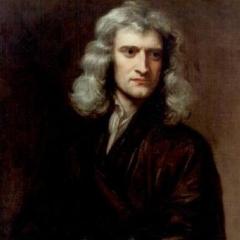
Isaac Newton
Isaac Newton was an English physicist, mathematician, and astronomer, considered one of the greatest scientists in history. He made significant contributions to physics, mathematics, and astronomy, particularly with his three laws of motion and the law of universal gravitation. Newton's work had a profound impact on the development of modern science and engineering. more
You May Also Like
Source: Tales of Wonder
“We need not hesitate to admit that the Sun is richly stored with inhabitants.”
Source: The Scientific Papers of Sir William Herschel
“The State is to make what is useful. The individual is to make what is beautiful.”
Source: Miscellaneous Aphorisms: The Soul of Man
“The State must follow, and not lead, the character and progress of the citizen.”
Source: Hegel's Philosophy of right
Source: Faust