Quotessence
Home / Quotes / Quote by John Steinbeck

Quote by John Steinbeck

“We have not known a single great scientist who could not discourse freely and interestingly with a child. Can it be that haters of clarity have nothing to say, have observed nothing, have no clear picture of even their own fields?”

Quote by John Steinbeck

Work

The Log from the Sea of Cortez

This book offers a blend of natural history, scientific inquiry, and philosophical musings, reflecting Steinbeck's deep appreciation for the marine environment and his friendship with Ricketts. more

Author
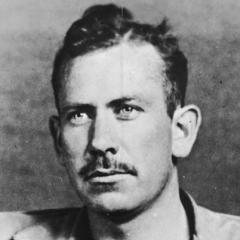
John Steinbeck
John Steinbeck

John Steinbeck was an American author renowned for his profound depiction of American society and the lives of farmers. His works often explore themes of poverty, social injustice, and human nature. Steinbeck was awarded the Nobel Prize in Literature in 1962 for his significant contribution to American literature. more

You May Also Like

“We have three approaches at our disposal: the observation of nature, reflection, and experimentation. Observation serves to assemble the data, reflection to synthesise them and experimentation to test the results of the synthesis. The observation of nature must be assiduous, just as reflection must be profound, and experimentation accurate. These three approaches are rarely found together, which explains why creative geniuses are so rare.”

“We receive experience from nature in a series of messages. From these messages we extract a content of information: that is, we decode the messages in some way. And from this code of information we then make a basic vocabulary of concepts and a basic grammar of laws, which jointly describe the inner organization that nature translates into the happenings and the appearances we meet.”

“What really matters for me is ... the more active role of the observer in quantum physics ... According to quantum physics the observer has indeed a new relation to the physical events around him in comparison with the classical observer, who is merely a spectator.”

“Whoever wishes to acquire a deep acquaintance with Nature must observe that there are analogies which connect whole branches of science in a parallel manner, and enable us to infer of one class of phenomena what we know of another. It has thus happened on several occasions that the discovery of an unsuspected analogy between two branches of knowledge has been the starting point for a rapid course of discovery.”

“With increasing distance, our knowledge fades, and fades rapidly. Eventually, we reach the dim boundary-the utmost limits of our telescopes. There, we measure shadows, and we search among ghostly errors of measurement for landmarks that are scarcely more substantial. The search will continue. Not until the empirical resources are exhausted, need we pass on to the dreamy realms of speculation.”