Quotessence
Home / Quotes / Quote by Terry Tempest Williams

Quote by Terry Tempest Williams

“Thomas Berry calls the Ecozoic Era, a time when we recognize the imperative of caring for the planet as a means of compassionate survival. We do not know what the outcome is going to be, but we have an opportunity to make these kinds of creative and imaginative leaps of thought and actions both locally and globally. This is completely antithetical to the direction George W. Bush is leading this nation. I do trust that the open space of democracy is ultimately the open space of our hearts and that we can follow our own leadership that carries a long-term view way beyond "four more years."”

Quote by Terry Tempest Williams

Author
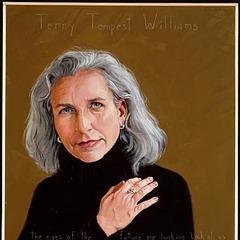
Terry Tempest Williams

Terry Tempest Williams is an American author known for her profound insights into the relationship between humans and nature. Her works often explore themes such as environmental protection, feminism, and identity. more

You May Also Like

“Hope is not attached to outcomes but is a state of mind, as Vaclav Havel says, "an orientation of the spirit." And I have faith; maybe more than hope, I have faith. I think of my great-grandmother, Vilate Lee Romney, who came from good pioneer Mormon stock. She always said to us that faith without works is dead, so I think if we have hope, we must work to further that hope. Maybe that is the most important thing of all, to have our faith rooted in action.”

“Hollywood is a very liberal community. There are a lot of guys that are also conservative that are frightened or fearful of being able to come out. And there's also the alternative. I'm one of the few conservatives that are involved with the Creative Coalition. It's trying to propagate the arts in schools and education, and a lot of things I believe in. It's a bipartisan thing, but when there is this strong partisanship... The other thing is, I'm pro-life, that's absolute, but I'm for live and let live. I'm an entertainer, I don't believe in stopping anyone's freedoms of lifestyle.”

“The film's title You Can't Be Neutral on a Moving Train. comes from something I used to say in teaching my students "This is not going to be a neutral class." The world is already moving in certain directions and wars are going on and children are going hungry. Terrible things are happening. And so to be neutral in a situation like this is to collaborate with whatever is going on. And I don't want to collaborate with the world as it is. I want to intrude myself. I want to participate in changing the direction of things. So that's the origin of the title.”

“I was just a seventeen-year-old kid, going to Times Square to participate in this left-wing demonstration. The signs were for peace and justice and so on. But then I was attacked by police mounted on horseback and on foot. Before I knew it, I was clubbed and knocked unconscious. So it gave me a radical view of the United States, a critical view of the role of the state and of the instruments of the state - the police, the Army, and so on - as not being neutral at all in political battles, but being generally against workers and against striking people, against dissenters of all kinds.”

“I began to think of war, even so-called "good wars" like World War II, as corrupting everybody. Violence begetting violence. The good guys beginning to act like the bad guys. And when I studied the history of wars, it seemed to me that that was the case. Athens vs. Sparta in the Peloponnesian War. The Athenians presumably the democratic state. The Spartans the totalitarian state. But as the war went on, the Athenians began to act like the Spartans. They began committing atrocities and cruelties. So I saw this as a characteristic of war, even so-called "good wars."”

“I did not feel very patriotic. I did not feel proud of our country, seeing that we were bombing peasant villages, that we were not just hitting military targets, that children were being killed. We were terrorizing the North Vietnamese with our enormous Air Force. They had no Air Force at all. They were a little pitiful country and we were terrorizing them with our bombs. And no, I did not feel proud at all.”

“Here's a president who gets 47 or 48 percent of the vote and takes 100 percent of the power, as if he had a mandate. He snuck into the presidency with the aid of political cronies, his father's having appointed members of the Supreme Court, his brother governor of Florida. And then he takes total control. And this is a president who seems to react to everything with force. Now we've had two wars. We've killed a lot of people. For anybody who is interested in not being a warlike nation anymore, and becoming a nation respected in the world, it becomes important to defeat Bush.”

“The stories coming out of Iraq everyday - the violence, the chaos, the deaths of Americans, the deaths of Iraqis... Of course the deaths of Iraqis are not played up as much. But when they count the corpses they see women and children. We are constantly killing the people who are suspected of something. Now, in the United States or under any decent system of justice, you don't kill people on suspicion. That's what you do when you bomb a house because there are suspected leaders there. But we've been doing that again and again and the result has been a toll of thousands of civilians.”

“The problem of giving health care to everybody cannot be solved so long as we're spending huge sums of money for war. Already we have a very wasteful healthcare system, the most wasteful healthcare system in the world. I mean, we spend the most money and still have 40 million people without insurance. Compare us to Cuba. Cuba is our enemy, run by a dictator, Fidel Castro. But people in Cuba get health care at least equal to that of the United States - with very scarce resources. So I think this issue is the most important domestic issue.”

“Though the Americans can be fooled, as they have been, and they can be propagandized, as they have been... But, as Lincoln said, "You can fool all of the people some of the time, and some of the people all of the time. But you can't fool all of the people all of the time." And so hope lies in the fact that little by little, even if the American people can be fooled, even if they continue to be fooled in the 2004 presidential election, they will gradually learn, as they have learned - for instance, in the Vietnam War and turned against the Vietnam War.”