Quotessence
Home / Quotes / Quote by P. G. Wodehouse

Quote by P. G. Wodehouse

“Mr Beach was too well bred to be inquisitive, but his eyebrows here not. 'Ah!' he said. '?', cried the eyebrows. '? ? ?' Ashe ignored the eyebrows. ... Mr Beach's eyebrows were still mutely urging him to reveal all, but Ashe directed his gaze at that portion of the room which Mr Beach did not fill. He was hanged if he was going to let himself be hypnotized by a pair of eyebrows into incriminating himself.”

Quote by P. G. Wodehouse

Author
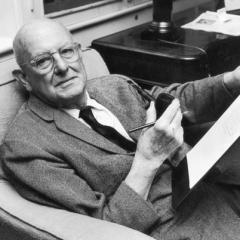
P. G. Wodehouse
P. G. Wodehouse

P. G. Wodehouse was a British writer, humorist, and composer, renowned for his humorous stories and novels, especially those featuring the characters Jeeves and Bertie Wooster. His works have been translated into many languages and have had a lasting impact on generations of readers. more

You May Also Like

“Joan was nothing more than a friend. He was not in love with her. One does not fall in love with a girl whom one has met only three times. One is attracted, yes; but one does not fall in love. A moment's reflection enabled him to diagnose his sensations correctly. This odd impulse to leap across the compartment and kiss Joan was not love. It was merely the natural desire of a good-hearted young man to be decently chummy with his species.”

“Way far back in the beginning of the world was the whirlwind warning that we could all be blown away like chips and cry- Men with tired eyes realize it now, and wait to deform and decay- with maybe they have the power of love yet in their hearts just the same, I just don't know what that word means anymore- All I want is an ice cream cone”

“Hamlet: Lady, shall I lie in your lap? Ophelia: No, my lord. Hamlet: DId you think I meant country matters? Ophelia: I think nothing, my lord. Hamlet: That's a fair thought to lie between maids' legs. Ophelia: What is, my lord? Hamlet: Nothing.”

“The Four Noble Truths are pragmatic rather than dogmatic. They suggest a course of action to be followed rather than a set of dogmas to be believed. The four truths are prescriptions for behavior rather than descriptions of reality. The Buddha compares himself to a doctor who offers a course of therapeutic treatment to heal one’s ills. To embark on such a therapy is not designed to bring one any closer to ‘the Truth’ but to enable one’s life to flourish here and now, hopefully leaving a legacy that will continue to have beneficial repercussions after one’s death. (154)”