Quotessence
Home / Quotes / Quote by Marcel Proust

Quote by Marcel Proust

“Theoretically, we know that the world turns, but in fact we do not notice it, the earth on which we walk does not seem to move andwe live on in peace. This is how it is concerning Time in our lives. And to render its passing perceptible, novelists must... have their readers cross ten, twenty, thirty years in two minutes.”

Quote by Marcel Proust

Author
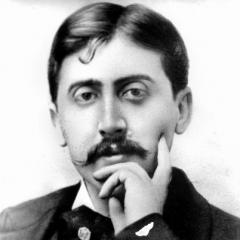
Marcel Proust
Marcel Proust

Marcel Proust was a French novelist renowned for his magnum opus, 'In Search of Lost Time'. This novel is considered a classic of 20th-century literature, known for its intricate psychological portrayals and profound exploration of memory. more

You May Also Like

“In times like ours, where the growing complexity of life leaves us barely the time to read the newspapers, where the map of Europehas endured profound rearrangements and is perhaps on the brink of enduring yet others, where so many threatening and new problems appear everywhere, you will admit it may be demanded of a writer that he be more than a fine wit who makes us forget in idle and byzantine discussions on the merits of pure form.”

“... But all the feelings that evoke in us the joy or the misfortune of a real person are only produced in us through the intermediary of an image of that joy or that misfortune; the ingeniousness of the first novelist was in understanding that, in the apparatus of our emotions, since the image is the only essential element, the simplification which consists of purely and simply suppressing the factual characters is a definitive improvement.”

“I blame the newspapers because every day they call our attention to insignificant things, while three or four times in our lives,we read books that contain essential things. Once we feverishly tear the band of paper enclosing our newspapers, things should change and we should find--I do not know--the Pensées by Pascal!”

“True variety is in that plenitude of real and unexpected elements, in the branch charged with blue flowers thrusting itself, against all expectations, from the springtime hedge which seems already too full, while the purely formal imitation of varietyis but void and uniformity, that is, that which is most opposed to variety.”

“For women who do not love us, as for the "disappeared", knowing that we no longer have any hope does not prevent us form continuing to wait. We live on our guard, on watch; women whose son has gone asea on a dangerous exploration imagine at any minute, although it has long been certain that he has perished, that he will enter, miraculously saved, and healthy.”

“I find very reasonable the Celtic belief that the souls of our dearly departed are trapped in some inferior being, in an animal, aplant, an inanimate object, indeed lost to us until the day, which for some never arrives, when we find that we pass near the tree, or come to possess the object which is their prison. Then they quiver, call us, and as soon as we have recognized them, the spell is broken. Freed by us, they have vanquished death and return to live with us.”

“At a certain age, we have already been struck by love; it no longer develops alone, according to its own mysteries and fateful laws while our hearts stand by startled and passive. We come to its assistanceRecognizing one of its symptoms, we recall, we bring back to life the others. Since we possess its song engraved in its totality within us, we do not need for a woman to tell us the beginning--filled with admiration inspired by beauty--to find the continuation.”

“... in love, barriers cannot be destroyed from the outside by the one to whom the cause despair, no matter what he does; and it isonly when he is no longer concerned with them that, suddenly, as a result of work coming from elsewhere, accomplished within the one who did not love him, these barriers, formerly attacked without success, fall futilely.”

“When I was small child, all that belonged to conservative society was fashionable, and no republicans were welcome in the smartersalons. People living in such a milieu could imagine that the impossibility of ever inviting an "opportunist", much less a "radical", was a thing that would last forever, like gas lamps and horse-drawn omnibuses. But similar to kaleidoscopes turning from time to time, society successively places in various ways elements which were thought to be immutable and creates a new composition.”