Quotessence
Home / Quotes / Quote by Joseph Priestley

Quote by Joseph Priestley

Work

The theological and miscellaneous works of Joseph Priestley

This comprehensive volume includes Priestley's contributions to both theological and scientific discourse, showcasing his work as a prominent figure in the Enlightenment era. more

Author
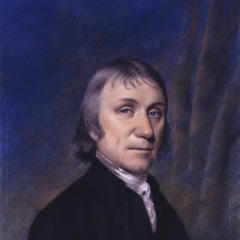
Joseph Priestley
Joseph Priestley

Joseph Priestley was an English philosopher, chemist, and deist. He is known for his contributions to the study of gases, particularly for his discovery of oxygen. Priestley was an advocate of empiricism in philosophy and also made contributions to the field of education. more

You May Also Like

“In my own view, some advice about what should be known, about what technical education should be acquired, about the intense motivation needed to succeed, and about the carelessness and inclination toward bias that must be avoided is far more useful than all the rules and warnings of theoretical logic.”

“In physics we deal with states of affairs much simpler than those of psychology and yet we again and again learn that our task is not to investigate the essence of things-we do not at all know what this would mean&mash;but to develop those concepts that allow us to speak with each other about the events of nature in a fruitful manner.”

“It is a right, yes a duty, to search in cautious manner for the numbers, sizes, and weights, the norms for everything [God] has created. For He himself has let man take part in the knowledge of these things ... For these secrets are not of the kind whose research should be forbidden; rather they are set before our eyes like a mirror so that by examining them we observe to some extent the goodness and wisdom of the Creator.”

“It is better to have a few forms well known than to teach a little about many hundred species. Better a dozen specimens thoroughly studied as the result of the first year's work, than to have two thousand dollars' worth of shells and corals bought from a curiosity-shop. The dozen animals would be your own.”

“It is not enough to say that we cannot know or judge because all the information is not in. The process of gathering knowledge does not lead to knowing. A child's world spreads only a little beyond his understanding while that of a great scientist thrusts outward immeasurably. An answer is invariably the parent of a great family of new questions. So we draw worlds and fit them like tracings against the world about us, and crumple them when we find they do not fit and draw new ones.”

“It is not knowledge, but the act of learning, not possession but the act of getting there, which grants the greatest enjoyment. When I have clarified and exhausted a subject, then I turn away from it, in order to go into darkness again; the never-satisfied man is so strange if he has completed a structure, then it is not in order to dwell in it peacefully,but in order to begin another. I imagine the world conqueror must feel thus, who, after one kingdom is scarcely conquered, stretches out his arms for others.”