Quotessence
Home / Quotes / Quote by Aleksandr Solzhenitsyn

Quote by Aleksandr Solzhenitsyn

Work

The First Circle

This book is a profound exploration of the human condition, delving into the complexities of life, morality, and the search for meaning. Set in a fictional setting, it follows a group of individuals who are engaged in a quest for self-discovery and understanding. more
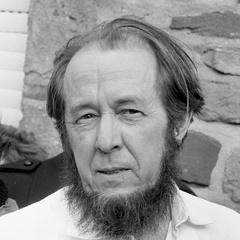
Author

Aleksandr Solzhenitsyn

Aleksandr Solzhenitsyn, a Russian novelist, was born on December 11, 1918, and died on August 3, 2008. He is renowned for his works that profoundly exposed the dark side of the Soviet political system and is considered one of the greatest writers of the 20th century. more

You May Also Like

“In other words, if a patent forgery like the "Protocols of the Elders of Zion" is believed by so many people that it can become the text of a whole political movement, the task of the historian is no longer to discover a forgery. Certainly it is not to invent explanations which dismiss the chief political and historical facts of the matter: that the forgery is being believed. This fact is more important than the (historically speaking, secondary) circumstance that it is a forgery.”

“There is, therefore, a temptation to return to an explanation which automatically discharges the victim of responsibility: it seems quite adequate to a reality in which nothing strikes us more forcefully than the utter innocence of the individual caught in the horror machine and his utter inability to change his fate. Terror, however, is only in the last instance of its development a mere form of government. In order to establish a totalitarian regime, terror must be presented as an instrument for carrying out a specific ideology; and that ideology must have won the adherence of many, and even a majority, before terror can be stabilized. The point for the historian is that the Jews, before becoming the main victims of modern terror, were the center of Nazi ideology. And an ideology which has to persuade and mobilize people cannot choose its victim arbitrarily.”

“Significantly, it was Disraeli who said, "What is a crime among the multitude is only a vice among the few"—perhaps the most profound insight into the very principle by which the slow and insidious decline of nineteenth-century society into the depth of mob and underworld morality took place. Since he knew this rule, he knew also that Jews would have no better chances anywhere than in circles which pretended to be exclusive and to discriminate against them; for inasmuch as these circles of the few, together with the multitude, thought of Jewishness as a crime, this "crime" could be transformed at any moment into an attractive "vice." Disraeli's display of eroticism, strangeness, mysteriousness, magic, and power drawn from secret sources, was aimed correctly at this disposition in society.”

“But he knew his Boss. One must never work full force for Stalin, never go all out. He did not tolerate the flat failure to carry out his orders, but he hated thoroughly successful performance because he saw in it a diminution of his own uniqueness. No one but himself must be able to do anything flawlessly. So even when he seemed to be straining in harness, Abakumov was pulling at half-strength—and so was everyone else. Just as King Midas turned everything to gold, Stalin turned everything to mediocrity.”

“Chelnov directed Rubin's attention to the geography of Moses' crossing. From the Nile to Jerusalem the Jews had at most 250 miles to go, and that meant that even if they rested on the Sabbath they could have easily covered the distance in three weeks. Wasn't it necessary therefore to assume that for the remaining forty years Moses did not simply lead them but misled them all over the Arabian desert?”