Quotessence
Home / Quotes / Quote by Aleksandr Solzhenitsyn

Quote by Aleksandr Solzhenitsyn

“Chelnov directed Rubin's attention to the geography of Moses' crossing. From the Nile to Jerusalem the Jews had at most 250 miles to go, and that meant that even if they rested on the Sabbath they could have easily covered the distance in three weeks. Wasn't it necessary therefore to assume that for the remaining forty years Moses did not simply lead them but misled them all over the Arabian desert?”

Quote by Aleksandr Solzhenitsyn

Work

The First Circle

This book is a profound exploration of the human condition, delving into the complexities of life, morality, and the search for meaning. Set in a fictional setting, it follows a group of individuals who are engaged in a quest for self-discovery and understanding. more

Author

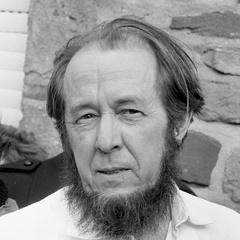
Aleksandr Solzhenitsyn

Aleksandr Solzhenitsyn, a Russian novelist, was born on December 11, 1918, and died on August 3, 2008. He is renowned for his works that profoundly exposed the dark side of the Soviet political system and is considered one of the greatest writers of the 20th century. more

You May Also Like

“The birth and growth of modern antisemitism has been accompanied by and interconnected with Jewish assimilation, the secularization and withering away of the old religious and spiritual values of Judaism. What actually happened was that great parts of the Jewish people were at the same time threatened by physical extinction from without and dissolution from within. In this situation, Jews concerned with the survival of their people would, in a curious and desperate misinterpretation, hit on the consoling idea that antisemitism, after all, might be an excellent means for keeping the people together so that the assumption of external antisemitism would even imply an external guarantee of Jewish existence. This superstition, a secularized travesty of the idea of eternity inherent in a faith in chosenness and a Messianic hope, has been strengthened through the fact that for many centuries the Jews experienced the Christian brand of hostility which was indeed a powerful agent of preservation, spiritually as well as politically. The Jews mistook modern anti-Christian antisemitism for the old religious Jew-hatred—and this all the more innocently because their assimilation had by-passed Christianity in its religious and cultural aspect. Confronted with an obvious symptom of the decline of Christianity, they could therefore imagine in all ignorance that this was some revival of the so-called "Dark Ages." Ignorance or misunderstanding of their own past were partly responsible for their fatal underestimation of the actual and unprecedented dangers which lay ahead. But one should also bear in mind that lack of political ability and judgment have been caused by the very nature of Jewish history, the history of a people without a government, without a country, and without a language. Jewish history offers the extraordinary spectacle of a people, unique in this respect, which began its history with a well-defined concept of history and an almost conscious resolution to achieve a well-circumscribed plan on earth and then, without giving up this concept, avoided all political action for two thousand years. The result was that the political history of the Jewish people became even more dependent upon unforeseen, accidental factors than the history of other nations, so that the Jews stumbled from one role to the other and accepted responsibility for none.”

“...I began pulling out old pictures and yearbooks from our Los Angeles high schools and UC Berkeley. Suddenly there we were, thousands of trim-haired, neatly-dressed, conservative-looking youngsters, with perky, forced smiles, encased in identical inch by inch-and-a-quarter boxes for our children to snicker at. Only they did not snicker. “Mom, this isn’t the 60s, is it?”

“Pobre de aquel país que no tenga una minoría en un Parlamento que se sepa levantar con valentía a defender los derechos de la Nación, porque cuando llegue ese momento no estaremos en el mundo libre, no estaremos en una República donde tendremos el derecho a hablar y exponer nuestras ideas libre y francamente. Eso es lo grande y lo bello en una democracia, donde podemos expresar nuestras ideas y tratar de conseguir los votos para aprobar un Proyecto de Ley.”

“A wise leader made an attention-grabbing statement that's stayed with me for decades. He declared, "I've made it a general principle to refrain from promoting anyone to a place of authority whose record is perfect." When asked why, he answered, "I learn more about a person's character by their response to failure than anything else. Did they own responsibility, repent, and grow from the experience? Or did they justify their behavior and delegate the blame? It shows if he or she is fit for responsibility." What I learned from that was: it indicates if wisdom is what he or she prizes above all else.”

“The LORD through His prophet, Jeremiah, said, “For my people are foolish; they know me not; they are stupid children; they have no understanding. They are ‘wise’ in doing evil! But how to do good they know not.” (Jeremiah 4: 22). Will this rebuke hold true for you? Sad to note that our knowledge of the LORD is at a play school level. In contrast to our knowledge on the heads of the government, politics, politicians, sports, celebrities, elders, believers, neighbours, friends, relatives, wife, husband, children, our own subjects of expertise etc., which can fetch us a doctoral degree! Shameful, isn’t it? Time to get back on course to pursue after the knowledge of the LORD.”