Quotessence
Home / Quotes / Quote by Arthur Eddington

Quote by Arthur Eddington

“Man is slightly nearer to the atom than to the star. ... From his central position man can survey the grandest works of Nature with the astronomer, or the minutest works with the physicist. ... [K]nowledge of the stars leads through the atom; and important knowledge of the atom has been reached through the stars.”

Quote by Arthur Eddington

Author
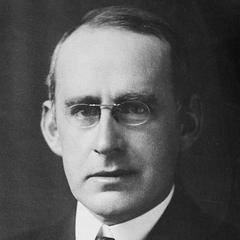
Arthur Eddington
Arthur Eddington

Arthur Eddington was a distinguished British astronomer recognized for his contributions to astrophysics and cosmology. He is particularly renowned for his observations during the 1919 solar eclipse, which validated Einstein's theory of general relativity. Eddington's legacy in astronomy has significantly advanced our comprehension of the cosmos. more

You May Also Like

“My picture of the world is drawn in perspective and not like a model to scale. The foreground is occupied by human beings and the stars are all as small as three-penny bits. I don't really believe in astronomy, except as a complicated description of part of the course of human and possibly animal sensation. I apply my perspective not merely to space but also to time. In time the world will cool and everything will die; but that is a long time off still and its present value at compound discount is almost nothing.”

“Science only means knowledge; and for [Greek] ancients it did only mean knowledge. Thus the favorite science of the Greeks was Astronomy, because it was as abstract as Algebra. ... We may say that the great Greek ideal was to have no use for useful things. The Slave was he who learned useful things; the Freeman was he who learned useless things. This still remains the ideal of many noble men of science, in the sense they do desire truth as the great Greeks desired it; and their attitude is an external protest against vulgarity of utilitarianism.”

“The end of the eighteenth and the commencement of the nineteenth century are remarkable for the small amount of scientific movement going on in this country, especially in its more exact departments. Mathematics were at the last gasp, and astronomy nearly so; I mean in those members of its frame which depend upon precise measurement and systematic calculation. The chilling torpor of routine had begun to spread itself over all those branches of Science which wanted the excitement of experimental research.”

“To most people, I fancy, the stars are beautiful; but if you asked why, they would be at a loss to reply, until they remembered what they had heard about astronomy, and the great size and distance and possible habitation of those orbs. ... [We] persuade ourselves that the power of the starry heavens lies in the suggestion of astronomical facts.”