Quotessence
Home / Quotes / Quote by Aristotle

Quote by Aristotle

“How strange it is that Socrates, after having made the children common, should hinder lovers from carnal intercourse only, but should permit love and familiarities between father and son or between brother and brother, than which nothing can be more unseemly, since even without them love of this sort is improper. How strange, too, to forbid intercourse for no other reason than the violence of the pleasure, as though the relationship of father and son or of brothers with one another made no difference.”

Quote by Aristotle

Work

Aristotle's Politics: Writings from the Complete Works: Politics, Economics, Constitution of Athens

Aristotle's Politics is a comprehensive treatise on political theory and governance, drawing from his extensive study of the political systems of his time, particularly the constitution of Athens. The book delves into the principles of government, economic theory, and the social structures that underpin political organization. more

Author
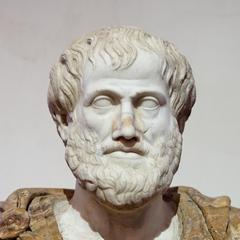
Aristotle
Aristotle

Aristotle, a renowned Greek philosopher, is one of the founders of Western philosophy. His thoughts covered a wide range of fields, including ethics, logic, politics, and had a profound impact on the world. more

You May Also Like

“If they do not share equally enjoyments and toils, those who labor much and get little will necessarily complain of those who labor little and receive or consume much. But indeed there is always a difficulty in men living together and having all human relations in common, but especially in their having common property.”

“Property should be in a certain sense common, but, as a general rule, private; for, when every one has a distinct interest, men will not complain of one another, and they will make more progress, because every one will be attending to his own business.”

“The error of Socrates must be attributed to the false notion of unity from which he starts. Unity there should be, both of the family and of the state, but in some respects only. For there is a point at which a state may attain such a degree of unity as to be no longer a state, or at which, without actually ceasing to exist, it will become an inferior state, like harmony passing into unison, or rhythm which has been reduced to a single foot. The state, as I was saying, is a plurality which should be united and made into a community by education”

“All three states - the Lacedaemonian, the Cretan, and the Carthaginian - nearly resemble one another, and are very different from any others. Many of the Carthaginian institutions are excellent. The superiority of their constitution is proved by the fact that the common people remains loyal to the constitution; the Carthaginians have never had any rebellion worth speaking of, and have never been under the rule of a tyrant.”

“The laws are, and ought to be, relative to the constitution, and not the constitution to the laws. A constitution is the organization of offices in a state, and determines what is to be the governing body, and what is the end of each community. But laws are not to be confounded with the principles of the constitution; they are the rules according to which the magistrates should administer the state, and proceed against offenders.”

“If what was said in the Ethics is true, that the happy life is the life according to virtue lived without impediment, and that virtue is a mean, then the life which is in a mean, and in a mean attainable by every one, must be the best. And the same principles of virtue and vice are characteristic of cities and of constitutions; for the constitution is in a figure the life of the city.”