Quotessence
Home / Quotes / Quote by Jean Piaget

Quote by Jean Piaget

“Before games are played in common, no rules in the proper sense can come into existence. Regularities and ritualized schemas are already there, but these rites, being the work of the individual, cannot call forth that submission to something superior to the self which characterizes the appearance of any rule.”

Quote by Jean Piaget

Work

The Moral Judgement of the Child

This book delves into the evolution of a child's moral judgment, examining how children learn to differentiate right from wrong and develop ethical reasoning. more

Author
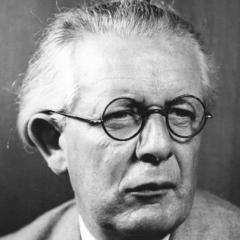
Jean Piaget
Jean Piaget

Swiss psychologist and the founder of the theory of cognitive development. Piaget's research has had a profound impact on fields such as educational psychology and child psychology. more

You May Also Like

“As far as the game of marbles is concerned, there is therefore no contradiction between the egocentric practice of games and the mystical respect entertained for rules. This respect is the mark of a mentality fashioned, not by free cooperation between equals, but by adult constraint.”

“In certain circumstances where he experiments in new types of conduct by cooperating with his equals, the child is already an adult. There is an adult in every child and a child in every adult. ... There exist in the child certain attitudes and beliefs which intellectual development will more and more tend to eliminate: there are others which will acquire more and more importance. The later are not derived from the former but are partly antagonistic to them.”

“Mixture of assimilation to earlier schemas and adaptation to the actual conditions of the situation is what defines motor intelligence. But and this is where rules come into existence as soon as a balance is established between adaptation and assimilation, the course of conduct adopted becomes crystallized and ritualized. New schemas are even established which the child looks for and retains with care, as though they were obligatory or charged with efficacy.”

“There is little mysticism without an element of transcendence, and conversely, there is no transcendence without a certain degree of egocentrism. It may be that the genesis of these experiences is to be sought in the unique situation of the very young child in relation to adults. The theory of the filial origin of the religious sense seems to us singularly convincing in this connection.”

“The discussion of the game of marbles seems to have led us into rather deep waters. But in the eyes of children the history of the game of marbles has quite as much importance as the history of religion or of forms of government. It Is a history, moreover, that is magnificently spontaneous; and it was therefore perhaps not entirely useless to seek to throw light on the child's judgment of moral value by a preliminary study of the social behaviour of children amongst themselves.”

“The need to speak the truth and even to seek it for oneself is only conceivable in so far as the individual thinks and acts as one of a society, and not of any society (for it is just the constraining relations between superior and inferior that often drive the latter to prevarication) but of a society founded on reciprocity and mutual respect, and therefore on cooperation.”

“It is as his own mind comes into contact with others that truth will begin to acquire value in the child's eyes and will consequently become a moral demand that can be made upon him. As long as the child remains egocentric, truth as such will fail to interest him and he will see no harm in transposing facts in accordance with his desires.”