Quotessence
Home / Quotes / Quote by Mahatma Gandhi

Quote by Mahatma Gandhi

“I do believe that, where there is only a choice between cowardice and violence, I would advise violence. I would rather have India resort to arms in order to defend her honour than that she should, in a cowardly manner, become or remain a helpless witness to her own dishonour. But I believe that nonviolence is infinitely superior to violence, forgiveness is more manly than punishment.”

Quote by Mahatma Gandhi

Work

Soul Force: Gandhi's Writings on Peace

Soul Force: Gandhi's Writings on Peace is a compilation of essays and speeches by Mahatma Gandhi, focusing on his profound thoughts and strategies for achieving peace through non-violent means. The book delves into his philosophy of satyagraha, or truth-force, and its application in various contexts, including social, political, and spiritual realms. more

Author
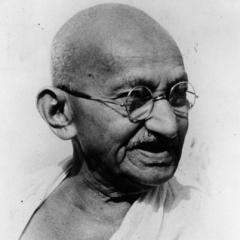
Mahatma Gandhi
Mahatma Gandhi

A leader of the Indian independence movement, lawyer, politician, and social activist, Mahatma Gandhi is revered as the 'Father of the Nation'. He advocated for non-violence and unity between Hindus and Muslims, leading the Indian struggle for independence and profoundly influencing history both in India and around the world. more

You May Also Like

“I have been repeating over and over again that he who cannot protect himself or his nearest and dearest or their honour by non-violently facing death may and ought to do so by violently dealing with the oppressor. He who can do neither of the two is a burden. He has no business to be the head of a family. He must either hide himself, or must rest content to live for ever in helplessness and be prepared to crawl like a worm at the bidding of a bully.”

“Whilst I may not actually help anyone to retaliate, I must not let a coward seek shelter behind nonviolence so-called. Not knowing the stuff of which nonviolence is made, many have honestly believed that running away from danger every time was a virtue compared to offering resistance, especially when it was fraught with danger to one's life. As a teacher of nonviolence I must, so far as it is possible for me, guard against such an unmanly belief.”

“Though violence is not lawful, when it is offered in self-defense or for the defense of the defenseless, it is an act of bravery far better than cowardly submission. The latter befits neither man nor woman. Under violence, there are many stages and varieties of bravery. Every man must judge this for himself. No other person can or has the right.”

“The political superstition is still holding sway over the hearts and minds of the masses, but the true lovers of liberty will have no more to do with it. Instead, they believe with Stirner that man has as much liberty as he is willing to take. Anarchism therefore stands for direct action, the open defiance of, and resistance to, all laws and restrictions, economic, social, and moral. But defiance and resistance are illegal. Therein lies the salvation of man. Everything illegal necessitates integrity, self-reliance and courage.”

“Direct action against the authority in the shop, direct action against the authority of the law, direct action against the invasive, meddlesome authority of our moral code, is the logical, consistent method of Anarchism. Will it not lead to a revolution? Indeed, it will. No real social change has ever come without a revolution. People are either not familiar with their history, or they have not yet learned that revolution is but thought carried into action.”

“At the meeting I argued that the state had given us no alternative to violence. I said it was wrong and immoral to subject our people to armed attacks by the state without offering them some kind of alternative. I mentioned again that people on their own had taken up arms. Violence would begin whether we initiated it or not. Would it not be better to guide this violence ourselves, according to principles where we saved lives by attacking symbols of oppression, and not people? If we did not take the lead now, I said, we would soon be latecomers and followers to a movement we did not control.”