Quotessence
Home / Quotes / Quote by Eric Hoffer

Quote by Eric Hoffer

“To find the cause of our ills in something outside ourselves, something specific that can be spotted and eliminated, is a diagnosis that cannot fail to appeal. To say that the cause of our troubles is not in us but in the Jews , and pass immediately to the extermination of the Jews, is a prescription likely to find a wide acceptance.”

Quote by Eric Hoffer

Work

The Passionate State of Mind

This book delves into the intricate tapestry of human emotions, focusing on the dynamics of relationships and the profound impact they have on individuals' lives. more

Author
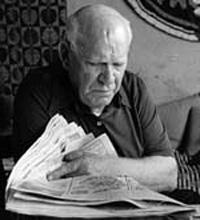
Eric Hoffer
Eric Hoffer

Eric Hoffer was an American philosopher known for his profound insights into human nature. His works often explore society, politics, and human behavior, particularly focusing on the experiences of the underclass. Hoffer came from a German immigrant family and worked in various jobs in California during his youth, including dockworker, cook, and gardener. His first book, 'The Ordeal of Change', was published in 1950 and quickly became a bestseller, gaining him widespread recognition. His other works include 'The Ordeal of Change' and 'The True Believer' among others. more

You May Also Like

“One wonders whether a generation that demands instant satisfaction of all its needs and instant solution of the world's problems will produce anything of lasting value. Such a generation, even when equipped with the most modern technology, will be essentially primitive it will stand in awe of nature, and submit to the tutelage of medicine men.”

“To think out a problem is not unlike drawing a caricature. You have to exaggerate the salient point and leave out that which is not typical. "To illustrate a principle ," says Bagehot , "you must exaggerate much and you must omit much." As to the quantity of absolute truth in a thought : it seems to me the more comprehensive and unobjectionable a thought becomes, the more clumsy and unexciting it gets. I like half-truths of a certain kind they are interesting and they stimulate.”

“In products of the human mind, simplicity marks the end of a process of refining, while complexity marks a primitive stage. Michelangelo 's definition of art as the purgation of superfluities suggests that the creative effort consists largely in the elimination of that which complicates and confuses a pattern.”