Quotessence
Home / Quotes / Quote by John Desmond Bernal

Quote by John Desmond Bernal

“[In eighteenth-century Britain] engineers for the most began as simple workmen, skilful and ambitious but usually illiterate and self-taught. They were either millwrights like Bramah, mechanics like Murdoch and George Stephenson, or smiths like Newcomen and Maudslay.”

Quote by John Desmond Bernal

Author
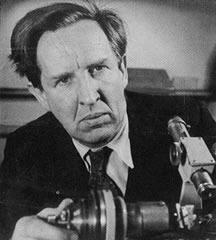
John Desmond Bernal
John Desmond Bernal

John Desmond Bernal was a prominent physicist, born on May 10, 1901, and died on September 15, 1971. He made significant contributions to quantum mechanics and solid-state physics. more

You May Also Like

“[Serialism] is like a sailless ship, driven out to sea by its captain, who has grown tired of its being used only as a pontoon, and who is privately convinced that by subjecting life aboard to the rules of an elaborate protocol, he will prevent the crew from thinking nostalgically either of their home port or of their ultimate destination.…”

“The order and harmony of the Western world, its most famous achievement, and a laboratory in which structures of a complexity as yet unknown are being fashioned, demand the elimination of a prodigious mass of noxious by-products which now contaminate the globe. The first thing we see as we travel round the world is our own filth, thrown into the face of mankind.”

“While I complain of being able to glimpse no more than the shadow of the past, I may be insensitive to reality as it is taking shape at this very moment, since I have not reached the stage of development at which I would be capable of perceiving it. A few hundred years hence, in this same place, another traveller, as despairing as myself, will mourn the disappearance of what I might have seen, but failed to see.”

“Not only does a journey transport us over enormous distances, it also causes us to move a few degrees up or down in the social scale. It displaces us physically and also for better or for worse takes us out of our class context, so that the colour and flavour of certain places cannot be dissociated from the always unexpected social level on which we find ourselves in experiencing them.”

“The work of the painter, the poet or the musician, like the myths and symbols of the savage, ought to be seen by us, if not as a superior form of knowledge, at least as the most fundamental and the only one really common to us all; scientific thought is merely the sharp point more penetrating because it has been whetted on the stone of fact, but at the cost of some loss of substance and its effectiveness is to be explained by its power to pierce sufficiently deeply for the main body of the tool to follow the head.”