Quotessence
Home / Quotes / Quote by Snorri Sturluson

Quote by Snorri Sturluson

“Norse mythology hints at Odinic cults, with Odin being worshipped through a combination of ecstatic and seemingly shamanistic rituals. From the eddic poem The Sayings of the High One ( Hávamál ), he is said to have hanged himself in a sacrificial ritual on a tree. Barely surviving this ordeal, Odin gains arcane knowledge, including the use of runes, the ancient Scandinavian alphabet sometimes used for magical purposes. In the poem, Odin chants : I know that I hung on the wind-swept tree all nine nights with spear was I wounded and given to Odin, myself to me, on that tree which no one knows from which roots it grows. Bread I was not given, no drink from the horn, downwards I glared; up I pulled the runes, screaming I took them, from there I fell back again. - excerpt from Jesse L. Byock's Introduction and Notes, of Sturluson's Prose Edda.”

Quote by Snorri Sturluson

Work

The Prose Edda: Norse Mythology

Browse quotes and source details for this work. more

Author
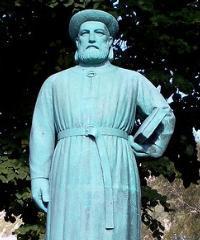
Snorri Sturluson
Snorri Sturluson

Snorri Sturluson was an Icelandic historian, considered one of the greatest writers of the North. He was born in 1179 and died on September 23, 1241. Snorri is renowned for his compilation of Icelandic and Norse history, particularly for his works 'Icelandic Kings' Sagas' and 'Edda'. more

You May Also Like

“Under the root *( of the Ash Yggdrasil ) that goes to the frost giants is the Well of Mimir. Wisdom and Intelligence are hidden there, and Mimir is the name of the well's owner. He is full of wisdom because he drinks of the well from the Gjallarhorn. All-father went there and asked for one drink from the well, but he did not get this until he gave one of his eyes as a pledge. As it says in The Sibyl's Prophesy : Odin, I know all, where you hid the eye in that famous Well of Mimir. Each morning Mimir drinks mead from Val-Father's pledge. Do you know now or what ? ( The Sibyl's Prophesy. 28 )”

“Può non essere sempre evidente ed esplicito nella forma del nome il nesso necessario con la sua ragione prima, ma ciò è dovuto soltanto all'ignoranza degli uomini, alla fuga del tempo, ed i sapienti, i saggi, i maghi e gli dèi sono tali in ragione delle loro maggiore o assoluta conoscenza di questi nessi. In origine ogni nome è una kenning. Ora essa, qual è praticata dagli scaldi, ci appare nel suo aspetto intellettualistico e concettoso di indovinello, nel riferimento ad una sapienza esclusiva ed esoterica, ma nostro è l'abbaglio nel percepirla così: nella struttura e nel senso suo più genuino essa è il modello originario del nome nel mito, un modello che può riflettersi in sé, nei suoi elementi costitutivi, all'infinito; primo e ultimo frutto dello sforzo di appropriazione del passato e del presente, di fare il mito.”

“Una parola specifica in norreno che dica 'mito' propriamente non esiste, potrebbe essere 'accadimento' oppure 'storia' o 'saga': per Snorri, ci sembra, quella che più si avvicina all'essenza del mito è la parola per 'ricordo', 'ricordare'. È sorprendente come riappaia più volte nella narrazione il 'ricordo' degli dèi: gli dèi si adunano e parlano e rammemorano quanto è avvenuto o quanto essi hanno compiuto, e questo par costituire agli occhi del narratore l'atto più proprio del loro sacro consesso. Il memorare, quasi che il ricordo costituisca un atto di vera e propria creazione, o forse, più pianamente, l'unico mezzo di conferma della realtà o verità cui riferirsi nella sconcertante poliedricità delle apparenze. Il ricordo è così l'unica vera esperienza del mito, il tempo del mito e la prospettiva della memoria secolare dell'uomo fino alla sua origine divina.”

“As Richard Slotkin has argued, frontier cultural forms that stressed regeneration through violence excused all kinds of nasty behavior. The myth freed colonists to chop heads, fire villages, and torture animals. This was wholesome, conservative brutality; atrocities committed in the name of order, authority, and decorum. Travelers’ tales and circle hunts made wildlife abuse socially acceptable. Regeneration through violence rested on the assumption (many times the delusion) of powerlessness. Wolves never threatened humans physically, but they devoured livestock, and colonists identified with their animal property.”

“As Hera crowned the youngest winner, the girl addressed the crowd: I am the new moon, swelling with magic, pure in my maidenhood, ever growing stronger. The second winner spoke: I am the full moon, complete in my powers, making people with my rhythms, bathing them in light. The third said: I am the waning moon, easing into peace, knowing all that went before, I am the wise one.”