Quotessence
Home / Quotes / Quote by Dante Alighieri

Quote by Dante Alighieri

Work

Inferno

Inferno is a gripping narrative that follows a protagonist on a perilous quest through a dangerous and mysterious world. The story is rich with historical and cultural references, and explores themes of morality and redemption. The novel is known for its intricate plot and vivid descriptions, offering readers a unique blend of suspense and intellectual stimulation. more
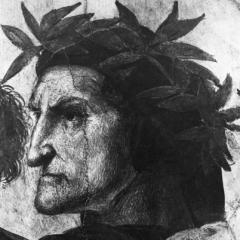
Author

Dante Alighieri
Dante Alighieri

Dante Alighieri, an Italian poet and a pioneer of the Renaissance, is hailed as the father of Italian literature. Born in 1265 and died on September 14, 1321, Dante is best known for his epic poem, 'The Divine Comedy,' which is not only a great literary work but also a profound religious and philosophical treatise. more

You May Also Like

“- A necessidade de comer e beber é simplesmente o instinto de autoconservação! - Mas não acha que esse instinto de autopreservação por si só é importante? Ora, o instinto de autoconservação é a lei normal da humanidade! - Quem lhe disse isso? Que é uma lei, não há dúvida. Mas não é mais normal do que a lei de destruição, ou mesmo a de autodestruição. Acha que a autoconservação seja a única lei da espécie humana?”

“All the great groups that stood about the Cross represent in one way or another the great historical truth of the time; that the world could not save itself. Man could do no more. Rome and Jerusalem and Athens and everything else were going down like a sea turned into a slow cataract. Externally indeed the ancient world was still at its strongest; it is always at that moment that the inmost weakness begins. But in order to understand that weakness we must repeat what has been said more than once; that it was not the weakness of a thing originally weak. It was emphatically the strength of the world that was turned to weakness and the wisdom of the world that was turned to folly. In this story of Good Friday it is the best things in the world that are at their worst. That is what really shows us the world at its worst. It was, for instance, the priests of a true monotheism and the soldiers of an international civilisation. Rome, the legend, founded upon fallen Troy and triumphant over fallen Carthage, had stood for a heroism which was the nearest that any pagan ever came to chivalry. Rome had defended the household gods and the human decencies against the ogres of Africa and the hermaphrodite monstrosities of Greece. But in the lightning flash of this incident, we see great Rome, the imperial republic, going downward under her Lucretian doom. Scepticism has eaten away even the confident sanity of the conquerors of the world. He who is enthroned to say what is justice can only ask: ‘What is truth?’ So in that drama which decided the whole fate of antiquity, one of the central figures is fixed in what seems the reverse of his true role. Rome was almost another name for responsibility. Yet he stands for ever as a sort of rocking statue of the irresponsible. Man could do no more. Even the practical had become the impracticable. Standing between the pillars of his own judgement-seat, a Roman had washed his hands of the world.”

“He shrugged. - They're just people - he said. - They're just doing what people do. Sir. Lord Vetinari gave him a friendly smile. - Of course, of course - he said. - You have to believe that, I appreciate. Otherwise you'd go quite mad. Otherwise you'd think you're standing on a feather-thin bridge over the vaults of Hell. Otherwise existence would be a dark agony and the only hope would be that there is no life after death. I quite understand.”

“What an immature, self-destructive, antiquated mischief is man! How obscure and gross his prancing and chattering on his little stage of evolution! How loathsome and beyond words boring all the thoughts and self-approval of his biological by-product! this half-formed, ill-conditioned body! this erratic, maladjusted mechanism of his soul: on one side the harmonious instincts and balanced responses of the animal, on the other the inflexible purpose of the engine, and between them man, equally alien from the being of Nature and the doing of the machine, the vile becoming!”