“Two weeks ago my mountain of mail delivered forth a pipsqueak mouse of a letter from a well-known publishing house that wanted to reprint my story “The Fog Horn” in a high school reader. In my story, I had described a lighthouse as having, late at night, an illumination coming from it that was a “God-Light.” Looking up at it from the view-point of any sea-creature one would have felt that one was in “the Presence.” The editors had deleted “God-Light” and “in the Presence.” Some five years back, the editors of yet another anthology for school readers put together a volume with some 400 (count ‘em) short stories in it. How do you cram 400 short stories by Twain, Irving, Poe, Maupassant and Bierce into one book? Simplicity itself. Skin, debone, demarrow, scarify, melt, render down and destroy. Every adjective that counted, every verb that moved, every metaphor that weighed more than a mosquito—out! Every simile that would have made a sub-moron’s mouth twitch—gone! Any aside that explained the two-bit philosophy of a first-rate writer—lost! Every story, slenderized, starved, bluepenciled, leeched and bled white, resembled every other story. Twain read like Poe read like Shakespeare read like Dostoevsky read like—in the finale—Edgar Guest. Every word of more than three syllables had been razored. Every image that demanded so much as one instant’s attention—shot dead. Do you begin to get the damned and incredible picture? How did I react to all of the above? By “firing” the whole lot. By sending rejection slips to each and every one. By ticketing the assembly of idiots to the far reaches of hell.”
Quote by Ray Bradbury
Book:Fahrenheit 451
Work
Fahrenheit 451
Ray Bradbury's Fahrenheit 451 is a thought-provoking novel set in a future society where books are banned and firemen are employed to burn any that are found. The story follows a fireman named Guy Montag who begins to question the status quo and the role of literature in society. more
Author
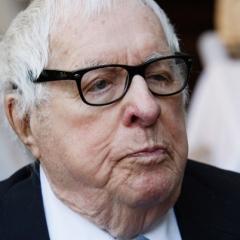
Ray Bradbury
Ray Bradbury, born on August 22, 1920, and died on June 5, 2012, was an influential American science fiction writer, playwright, and poet. His works are known for their unique imagination and profound philosophical insights, which have had a profound impact on the science fiction genre. more
You May Also Like
Source: A Devil's Chaplain: Reflections on Hope, Lies, Science, and Love
Source: The Life of One Kid 2
Source: Buys: 'n grensroman
“A poor person robs the bank whereas a rich person buys the government.”
Source: The Invention of Sound