Quotessence
Home / Quotes / Quote by Gustave Flaubert

Quote by Gustave Flaubert

“I am growing so peevish about my writing. I am like a man whose ear is true but who plays falsely on the violin: his fingers refuse to reproduce precisely those sounds of which he has the inward sense. Then the tears come rolling down from the poor scraper's eyes and the bow falls from his hand.”

Quote by Gustave Flaubert

Work

The letters

This book compiles and presents letters exchanged between various historical and contemporary figures, offering insights into their personal and professional relationships. more

Author

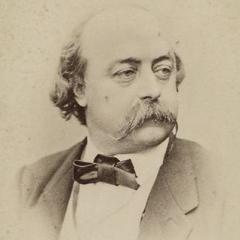
Gustave Flaubert
Gustave Flaubert

Gustave Flaubert, born on December 12, 1821 and died on May 8, 1880, was a prominent French writer of the 19th century. Known for his exquisite literary skills and profound psychological portrayals, Flaubert is best remembered for his masterpiece 'Madame Bovary'. more

You May Also Like

“As those who must worry about the livelihood of artists are fond of saying, “You cannot play ‘The Minute Waltz’ in less than a minute.” Worse (or perhaps better) you cannot write “The Minute Waltz” in less than … what? A day, a week, a year?—however long it takes. There is no technology, no time-saving device that can alter the rhythms of creative labor. When the worth of labor is expressed in terms of exchange value, therefore, creativity is automatically devalued every time there is an advance in the technology of work.”

“We do not see the grey working day, the cap and gown, the note-books, the feet burning from the pavements of picture galleries, but things ' that set the spirit free for a moment,' ' stirring of the senses/ ' strange dyes,' ' strange colours and curious odours,' ' work of the artist's hands,' ' passionate attitudes.' It is not the style of ecstasy such as can be seen in Jefferies' Story of My Heart, or Sterne's Journal to Eliza, or Keats' last letter to Fanny Brawne. Hardly does it appear to be the style of remembered ecstasy as in Traherne's Centuries of Meditation or Wordsworth's Tintern Abbey. It is free from traces of experience. All is subtilised, intellectualised, ' casting off all debris.' It is a polished cabinet of collections from history, nature, and art ; objects detached from their settings but almost never without being integrated afresh by Pater's careful arrangement, whether they are pictures, books, landscapes or personalities. It fulfils Pater's own condition of art by putting its own ' happy world ' in place of ' the meaner world of our common days.”

“Possessed of an absolute belief that there exists but one way of expressing one thing, one word to call it by, one adjective to qualify, one verb to animate it, he [Flaubert] gave himself to superhuman labour for the discovery, in every phrase, of that word, that verb, that epithet. In this way, he believed in some mysterious harmony of expression, and when a true word seemed to him to lack euphony still went on seeking another, with invincible patience, certain that he had not yet got hold of the unique word.... A thousand preoccupations would beset him at the same moment, always with this desperate certitude fixed in his spirit: Among all the expressions in the world, all forms and turns of expression, there is but one—one form, one mode—to express what I want to say.”

“As in living creatures, the blood, nourishing the body, determines its very contour and external aspect, just so, to his mind, the matter, the basis, in a work of art, imposed, necessarily, the unique, the just expression, the measure, the rhythm—the form in all its characteristics. If the style be the man, in all the colour and intensity of a veritable apprehension, it will be in a real sense "impersonal.”

“Jarret insists on being a throwback to some earlier, “simpler” time. Now does not suit him. Religious tolerance does not suit him. The current state of the country does not suit him. He wants to take us all back to some magical time when everyone believed in the same God, worshipped him in the same way, and understood that their safety in the universe depended on completing the same religious rituals and stomping anyone who was different. There was never such a time in this country. But these days when more than half the people in the country can’t read at all, history is just one more vast unknown to them.”