Quotessence
Home / Quotes / Quote by Reinhold Niebuhr

Quote by Reinhold Niebuhr

Work

Moral Man and Immoral Society: Study in Ethics and Politics

Browse quotes and source details for this work. more

Author
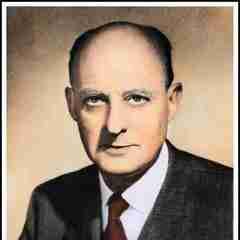
Reinhold Niebuhr
Reinhold Niebuhr

Reinhold Niebuhr was a prominent American theologian whose work on Christian ethics and social ethics had a profound impact on the 20th century. He was a key figure in theological discourse, particularly for his exploration of the nature of sin and the church's role in society. Niebuhr's theological thought has influenced various Christian denominations and has had a lasting effect on political and social thought. more

You May Also Like

“I’ve often wondered how the term “'New Atheism”' gained such currency. It is a misnomer. There is nothing new about nonbelief. All of us, without exception, are born knowing nothing of God or gods, and acquire notions of religion solely through interaction with others – or, most often, indoctrination by others, an indoctrination usually commencing well before we can reason. Our primal state is, thus, one of nonbelief. The New Atheists (most prominently Richard Dawkins, Sam Harris and the late Christopher Hitchens) have, in essence, done nothing more than try to bring us back to our senses, to return us to a pure and innate mental clarity.”

“What is this thing you call substance abuse? All I wanna do is forget and get loose. Drinking and smoking over and over What's so great about a life that's sober? There's nothing cool about being young When the monsters of night have stolen the sun. I'm tired of searching for words in the sky. All I wanna do is drink and die. Nothing is real. It's all a big lie. All I wanna do is drink and die. There's nothing cool about being young When the monsters of night have stolen the sun.”

“Einstein, twenty-six years old, only three years away from crude privation, still a patent examiner, published in the Annalen der Physik in 1905 five papers on entirely different subjects. Three of them were among the greatest in the history of physics. One, very simple, gave the quantum explanation of the photoelectric effect—it was this work for which, sixteen years later, he was awarded the Nobel prize. Another dealt with the phenomenon of Brownian motion, the apparently erratic movement of tiny particles suspended in a liquid: Einstein showed that these movements satisfied a clear statistical law. This was like a conjuring trick, easy when explained: before it, decent scientists could still doubt the concrete existence of atoms and molecules: this paper was as near to a direct proof of their concreteness as a theoretician could give. The third paper was the special theory of relativity, which quietly amalgamated space, time, and matter into one fundamental unity. This last paper contains no references and quotes to authority. All of them are written in a style unlike any other theoretical physicist's. They contain very little mathematics. There is a good deal of verbal commentary. The conclusions, the bizarre conclusions, emerge as though with the greatest of ease: the reasoning is unbreakable. It looks as though he had reached the conclusions by pure thought, unaided, without listening to the opinions of others. To a surprisingly large extent, that is precisely what he had done.”

“Back therefore we find ourselves returning. Back to the wisdom of the plough; back to the wisdom of those who follow the sea. It is all a matter of the wheel coming full-circle. For the sophisticated system of mental reactions to which we finally give our adherence is only the intellectualised reproduction of what more happily constituted natures, without knowing what they possess, possess. Thus between true philosophers and the true simple people there is a magnetic understanding; whereas, the clever ones whose bastard culture only divorces them from the wisdom of the earth remain pilloried and paralysed on the prongs of their own conceit".”

“I do not think anyone can read the letters which passed between Clarke and [Anthony] Collins without admitting that Collins, who writes with wonderful Power and closeness of reasoning, has by far the best of the argument, so far as the possible materiality of the soul goes; and that in this battle the Goliath of Freethinking overcame the champion of what was considered orthodoxy.”