Quotessence
Home / Quotes / Quote by Max Stirner

Quote by Max Stirner

“God cares only for what is his, busies himself with only himself, thinks only of himself, and has only himself before his eyes...He serves no higher person, and satisfies only himself. His cause is--A purely egoistic cause.”

Quote by Max Stirner

Author
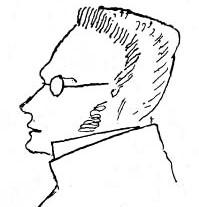
Max Stirner
Max Stirner

Max Stirner was a German philosopher born on October 25, 1806, and died on June 26, 1856. His philosophical thoughts revolve around individualism and egoism, which had a profound impact on later existentialism and nihilism. more

You May Also Like

“We are fed ideas in small sound bites that are really just the conclusions of particular beliefs. We do not examine what underpins these sound bites. If the sound bites are presented by a source we are accustomed to accepting as true, there is a danger we will assimilate the conclusion without knowing, or caring, whether it is based on solid arguments and assumptions.”

“He liked to start sentences with okay, so. It was a habit he had picked up from the engineers. He thought it made him sound smarter, thought it made him sound like them, those code jockeys, standing by the coffee machine, talking faster than he could think, talking not so much in sentences as in data structures, dense clumps of logic with the occasional inside joke. He liked to stand near them, pretending to stir sugar into his coffee, listening in on them as if they were speaking a different language. A language of knowing something, a language of being an expert at something. A language of being something more than an hourly unit.”

“There is nothing distinctively scientific about the hypothetico-deductive process. It is not even distinctively intellectual. It is merely a scientific context for a much more general stratagem that underlies almost all regulative processes or processes of continuous control, namely feedback, the control of performance by the consequences of the act performed. In the hypothetico-deductive scheme the inferences we draw from a hypothesis are, in a sense, its logical output. If they are true, the hypothesis need not be altered, but correction is obligatory if they are false. The continuous feedback from inference to hypothesis is implicit in Whewell's account of scientific method; he would not have dissented from the view that scientific behaviour can be classified as appropriately under cybernetics as under logic.”

“Majina ya vitabu yanapaswa kuchaguliwa kwa mantiki na kwa makini ya hali ya juu mno, kwa sababu ni miongoni mwa vitu vya kwanza watu wanavyoviona na kuvisoma. Watu wakivutiwa na jina la kitabu, au mwandishi; kitu cha pili watakachovutiwa kuangalia ni dibaji, kusudi wasome muhtasari wa kitabu kizima. Kwa hiyo dibaji inapaswa iandikwe kwa mantiki na kwa makini ileile iliyotumika katika kuchagua jina la kitabu. Lengo la jina la kitabu na dibaji ni kuishawishi hadhira kusoma kitabu na kukifurahia.”

“Braith turned and saw three of her cousins sunning themselves on boulders. Like lizards. Lizards in human form. “What are you doing?” Braith asked. “Enjoying the suns,” replied one. “It gives our scales a lovely bright hue,” said another. Braith blinked. “Except you’re all in your human form. So how does that help your scales?” They stared at her for several seconds before one stated, “You’re a bit of a know-it-all, aren’t you?” “How is that . . .” Braith shook her head. She wouldn’t go from arguing with one idiot to arguing with three.”