Quotessence
Home / Quotes / Quote by Yanis Varoufakis

Quote by Yanis Varoufakis

“Liberalism’s fatal hypocrisy […] was to rejoice in the virtuous Jills and Jacks, the neighborhood butchers, bakers and brewers, so as to defend the vile East India Companies, the Facebooks, the Amazons, which know no neighbors, have no partners, respect no moral sentiments [the other book by Adam Smith] and stop at nothing to destroy their competitors.”

Quote by Yanis Varoufakis

Work

Another Now: Dispatches from an Alternative Present

Browse quotes and source details for this work. more

Author
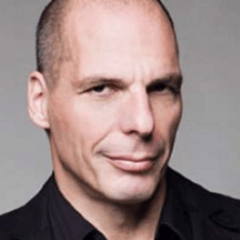
Yanis Varoufakis
Yanis Varoufakis

Yanis Varoufakis is a Greek economist and politician who served as the Finance Minister of Greece from 2015 to 2015. He is known for his role in the Greek debt crisis and his advocacy for a more democratic economic system. more

You May Also Like

“Smith’s concept of the mercantile system evolved—completely out of context—into the modern concept of mercantilism: a simplistic, blanket economic term used to characterize early modern economic thinkers as proponents of an interventionist, taxing, subsidizing, and warring state whose goal was to simply hoard gold. In 1931, the Swedish economic historian Eli Heckscher, in his monumental study Mercantilism, juxtaposed Colbert’s “mercantile” economics with a pure, laissez-faire system, which he felt Smith embodied, that allowed for individual and commercial freedoms without state intervention. A powerful and simplistic binary continued thereafter, one that informs our own vision of the free market today. We can see it still in Friedman’s work.”

“[Adam Smith] was above all an ethical thinker. He wrote the two books, The Theory of Moral Sentiments (1759, finishing the much-amended sixth edition just before he died, in 1790) and An Inquiry into the Nature and Causes of the Wealth of Nations (1776, with its own sixth edition, slightly amended, appearing in 1791). Such a meager output would make him a borderline case for tenure nowadays in many universities, and a sure-fire no in most departments of economics. “Good Lord,” the economists would say after a hurried look at his academic credentials, “he didn’t publish any articles in the American Economic Review reporting statistical tests or field experiments or mathematical proofs of existence!”

“Smith's defence of the market, like Hume's defence of property systems in general, is primarily socially oriented. It is still a defence of the market: markets need not be opposed to broad community-focused social goals, as the idea of market-socialism makes clear. But it is a big mistake to see it as a right-wing defence of the importance to the individual of their own property. The defence of markets developed by Smith and Hume takes this nuanced view on which my property is justified primarily by what it can do for others. Getting this clear is an important step in our understanding of the contested value of markets.”

“John Law’s role in resolving the Water Diamond Paradox has been largely forgotten. The name now associated with it is another Scottish economist, Adam Smith. Writing over seventy years after the publication of 'Money and Trade Considered', Smith’s celebrated restatement of the paradox of value, in 'An Inquiry into the Nature and Causes of the Wealth of Nations' is astonishing not for its originality, but for its similarity with John Law’s resolution decades before.”

“The Bayesian Invisible Hand … free-market capitalism and Bayes’ theorem come out of something of the same intellectual tradition. Adam Smith and Thomas Bayes were contemporaries, and both were educated in Scotland and were heavily influenced by the philosopher David Hume. Smith’s 'Invisible hand' might be thought of as a Bayesian process, in which prices are gradually updated in response to changes in supply and demand, eventually reaching some equilibrium. Or, Bayesian reasoning might be thought of as an 'invisible hand' wherein we gradually update and improve our beliefs as we debate our ideas, sometimes placing bets on them when we can’t agree. Both are consensus-seeking processes that take advantage of the wisdom of crowds. It might follow, then, that markets are an especially good way to make predictions. That’s really what the stock market is: a series of predictions about the future earnings and dividends of a company. My view is that this notion is 'mostly' right 'most' of the time. I advocate the use of betting markets for forecasting economic variables like GDP, for instance. One might expect these markets to improve predictions for the simple reason that they force us to put our money where our mouth is, and create an incentive for our forecasts to be accurate. Another viewpoint, the efficient-market hypothesis, makes this point much more forcefully: it holds that it is 'impossible' under certain conditions to outpredict markets. This view, which was the orthodoxy in economics departments for several decades, has become unpopular given the recent bubbles and busts in the market, some of which seemed predictable after the fact. But, the theory is more robust than you might think. And yet, a central premise of this book is that we must accept the fallibility of our judgment if we want to come to more accurate predictions. To the extent that markets are reflections of our collective judgment, they are fallible too. In fact, a market that makes perfect predictions is a logical impossibility.”

“Economists have always recognised that some kind of initial accumulation was necessary for the rise of capitalism. Adam Smith called this ‘previous accumulation’, and claimed that it came about because a few people worked really hard and saved their earnings– an idyllic tale that still gets repeated in economics textbooks. But historians see it as naïve. This was no innocent process of saving. It was a process of plunder.”

“The ethical autonomy the impartial spectator offers us is a deception that has the function of rendering us more profoundly sociable than we were when we were in a state of ethical childhood and dependency. Rousseau once famously remarked that while men were born free, everywhere they were in chains. In Smith’s view the chains were those of the imagination, chains that could be loosened by a common-sense, sceptical awareness of the processes by which the moral personality was formed, but never altogether thrown off. And while Smith’s account of the life of virtue lived under the direction of the impartial spectator might seem to be nothing more than a subtle deception to a Rousseaunian or a Christian, and while this fabric of deception was to trouble him at the end of his life, Smith was to argue that the satisfaction of being able to live sociably under the direction of the impartial spectator was enough for humankind, and enough to encourage the improvement of society and the progress of civilization from the self-evidently wretched condition in which it had hitherto existed.”

“Leadership is largely ignored by recent liberal theorists. I suspect that the very idea of leadership has a non-egalitarian and authoritarian quality to it, best left to those (inspired by Max Webber) with a fascination for charisma or revolution; or left to fascists or management consultants and organisational psychologists. But this neglect by liberal theorists comes at a cost. Institutions and procedures are run by imperfect human beings and without ongoing maintenance, care and investment they decay. While I do not claim that 'leadership' is a sufficient response to the challenges of institutional decay and renewal, it may well be a necessary one.”

“Good grief. Here is an eighteenth-century, middle class Scottish professor [Adam Smith] saying that morality is an accidental by-product of the way human beings adjust their behavior towards each other as they grow up; saying that morality is an emergent phenomenon that arises spontaneously among human beings in a relatively peaceful society; saying that goodness does not need to be taught, let alone associated with the superstitious belief that it would not exist but for the divine origin of an ancient Palestinian carpenter.”