“Every now and then, I'm lucky enough to teach a kindergarten or first-grade class. Many of these children are natural-born scientists - although heavy on the wonder side, and light on skepticism. They're curious, intellectually vigorous. Provocative and insightful questions bubble out of them. They exhibit enormous enthusiasm. I'm asked follow-up questions. They've never heard of the notion of a 'dumb question'. But when I talk to high school seniors, I find something different. They memorize 'facts'. By and large, though, the joy of discovery, the life behind those facts has gone out of them. They've lost much of the wonder and gained very little skepticism. They're worried about asking 'dumb' questions; they are willing to accept inadequate answers, they don't pose follow-up questions, the room is awash with sidelong glances to judge, second-by-second, the approval of their peers. They come to class with their questions written out on pieces of paper, which they surreptitiously examine, waiting their turn and oblivious of whatever discussion their peers are at this moment engaged in. Something has happened between first and twelfth grade. And it's not just puberty. I'd guess that it's partly peer pressure not to excel - except in sports, partly that the society teaches short-term gratification, partly the impression that science or mathematics won't buy you a sports car, partly that so little is expected of students, and partly that there are few rewards or role-models for intelligent discussion of science and technology - or even for learning for it's own sake. Those few who remain interested are vilified as nerds or geeks or grinds. But there's something else. I find many adults are put off when young children pose scientific questions. 'Why is the Moon round?', the children ask. 'Why is grass green?', 'What is a dream?', 'How deep can you dig a hole?', 'When is the world's birthday?', 'Why do we have toes?'. Too many teachers and parents answer with irritation, or ridicule, or quickly move on to something else. 'What did you expect the Moon to be? Square?' Children soon recognize that somehow this kind of question annoys the grown-ups. A few more experiences like it, and another child has been lost to science.”
Quote by Carl Sagan
Work
The Demon-Haunted World: Science as a Candle in the Dark
In this seminal work, the author delves into the principles of scientific inquiry, critical analysis, and evidence-based reasoning. The book serves as a guide to discerning fact from fiction, advocating for the importance of skepticism and rationality in understanding the natural world. more
Author
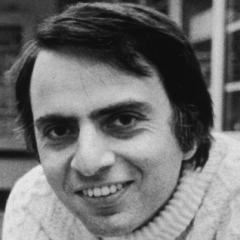
Carl Sagan
Carl Sagan was an American astronomer, cosmologist, author, and science communicator, born on November 9, 1934, in Brooklyn, New York. He is renowned for his profound research into the cosmos and his dedication to popularizing science. Sagan proposed numerous theories about the origin of the universe and life, and he made complex scientific knowledge accessible to the public with his unique perspective and clear, engaging writing style. more
You May Also Like
Source: THE RIGHT OF AUTHORS TO USE AI FREELY: Why AI Is a Tool, Not an Author
Source: Louis Pasteur Condemns Big Pharma: Vaccines, Drugs, and Healthcare in the United States
Source: Louis Pasteur Condemns Big Pharma: Vaccines, Drugs, and Healthcare in the United States
Source: Louis Pasteur Condemns Big Pharma: Vaccines, Drugs, and Healthcare in the United States
Source: Louis Pasteur Condemns Big Pharma: Vaccines, Drugs, and Healthcare in the United States
Source: Louis Pasteur Condemns Big Pharma: Vaccines, Drugs, and Healthcare in the United States