Quotessence
Home / Quotes / Quote by Naomi Klein

Quote by Naomi Klein

“We have dangerously warmed our world already, and our governments still refuse to take the actions necessary to halt the trend. There was a time when many had the right to claim ignorance. But for the past three decades, since the Intergovernmental Panel on Climate Change was created and climate negotiations began, this refusal to lower emissions has been accompanied with full awareness of the dangers. And this kind of recklessness would have been functionally impossible without institutional racism, even if only latent. It would have been impossible without Orientalism, without all the potent tools on offer that allow the powerful to discount the lives of the less powerful. These tools - of ranking the relative value of humans - are what allow the writing off of entire nations and ancient cultures. And they are what allowed for the digging up of all that carbon to begin with.”

Quote by Naomi Klein

Work

On Fire: The Case for the Green New Deal

Browse quotes and source details for this work. more

Author
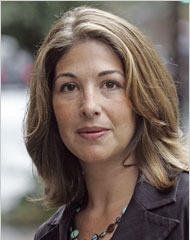
Naomi Klein
Naomi Klein

Naomi Klein is a Canadian author and activist recognized for her work on social justice and environmental issues. Born on May 8, 1970, she has authored several influential books that have gained international acclaim. more

You May Also Like

“But I learned from these new books that Southerners think we are really rather sad. They have an idea of a people dwelling on a mountain, inbred, lonely, mysterious; that we ritually climb and descend, and make sacrifices, and burn eternal flames, and send bridal parties from village to village in the spring so men like Daila can impregnate women like me, all in order to placate something implacable. They see our culture as rich, in the same way perhaps that a seam of ancient ore is rich — because of compression and repression. They imagine that we drink a lot, even more than we do (and it is a thing I learned from the bar, that they drink as much as we, that every culture that’s discovered alcohol drinks too much) and that we are poorer than we are because only a few of us sell anything to them. A melancholy drunken land, a land of storytellers, a land of sly jokes, an Asam-hating land, and nothing like the land I remembered. It was as if someone had constructed a scaffolding around us, and then removed us and written only about the scaffolding. The more I read, the more the materials of the scaffolding — splintered wood, narrow pipes of metal — slid into the hollows of my bones. I knew that the next time I went to the mountain, I would have a stranger’s mind in mine. Though I walked in streets I had known since girlhood, I would never again be able to step upon them without an erudite word in my head and a bracing of metal in my marrow.”

“Just outside the walls of the City, trouble was brewing. They came in boats from a land far across the sea. Many boats crammed with many hopefuls washed up on the shores in the shadow of the great cliffs. Like driftwood. These flotsam people were dazed, broken – perhaps at an extreme – optimistic. Surely there would be salvation within the thick city walls? They appeared in a whisper – like the hissing of the surf. No citizen came to welcome them. No delegates. No photo-ops for ambitious politicians. Instead, only the City’s military – soldiers and officers with faces as hard and blank as the cliff the City teetered upon – were waiting. They were herded in silence. Those without papers were left on the stony beach. There would be tents, bunks, and prefab houses in time. The lucky ones were escorted up the great lifts and transported along the subway system – out of sight. A Downtown station would process them. See this crowd of Driftwood people, Eva. See them huddle together in the dark, the glint of hope in their eyes. The color of their skin, how the women covered their hair, and how the men wore their beards – these were the superficial differences that would mark them so starkly here. The label of ‘other’ already hung around their necks without them even knowing.”

“The polarities of personality often present as victim and oppressor, the haves and the have nots, rights and wrongs, and other seemingly persistent divisions in our society. These polarities are not the source of this tension, but when we relate with the polarities through a reactionary state of operation, we can easily divide ourselves along those lines. Us and them. The familiar and the other. When we don't own our own wholeness, when we identity too much with something other than our core worth, we collapse into one pole, as in being with or against others. This othering process is myopic, in that it doesn't take into account that our own wholeness is dependent on reclaiming the alternate pole, the person we think we are not, the "other" within us. When we are able to relate with each pole from a place of responsiveness, where we stand in recognition of our own innate wholeness, the experience of polarity can be one of expansion, flow, contrast and generative transformation, rather than division. Once we reckon with the paradox of how the perceived other is both distinct, and a direct reflection of us, then we see ourselves in that mirror. We see everyone and everything as reflecting an aspect of ourself that we get to reclaim. Those we might have judged become guideposts for our own liberation. Our triggers become welcomed signs that we have rejected something inside us. The idea that you are either with us or against us is a limiting lens that perpetuates humanity's suffering. The recognition that you are us, that everyone is us, allows our self-love to humanize others into belonging.”

“Having a driving force to achieve your goals is not enough. You must connect with the why behind each goal to determine whether they will get you to the level of success your inner self will be satisfied with.”