Quotessence
Home / Quotes / Quote by Bertrand Russell

Quote by Bertrand Russell

“I think that what we mean in practice by reason can be defined by three characteristics. In the first place, it relies upon persuasion rather than force; in the second place, it seeks to persuade by means of arguments which the man who uses them believes to be completely valid; and in the third place, in forming opinions, it uses observation and induction as much as possible and intuition as little as possible. The first of these rules out the Inquisition; the second rules out such methods as those of British war propaganda, which Hitler praises on the ground that propaganda “must sink its mental elevation deeper in proportion to the numbers of the mass whom it has to grip”; the third forbids the use of such a major premise as that of President Andrew Jackson a propos of the Mississippi, “the God of the Universe intended this great valley to belong to one nation,” which was self-evident to him and his hearers, but not easily demonstrated to one who questioned it.”

Quote by Bertrand Russell

Work

The Will to Doubt

Browse quotes and source details for this work. more

Author
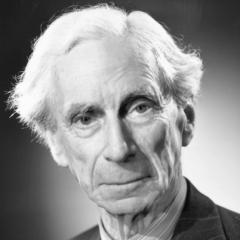
Bertrand Russell
Bertrand Russell

Bertrand Russell was a British philosopher, mathematician, and logician born on May 18, 1872, and died on February 2, 1970. He is known for his contributions to logic and mathematics, particularly in the fields of mathematical logic and philosophical analysis. His works spanned a wide range of subjects, including ethics, political philosophy, history, and literary criticism. more

You May Also Like

“You might object that people were asked ‘What do you think?’ rather than ‘What do you feel?’, but this is a common misperception. Referendums and elections are always about human feelings, not about human rationality. If democracy were a matter of rational decision-making, there would be absolutely no reason to give all people equal voting rights – or perhaps any voting rights. There is ample evidence that some people are far more knowledgeable and rational than others, certainly when it comes to specific economic and political questions.”

“Having learnt from experiment and argument that a stone falls downwards, a man indubitably believes this, and always expects the law he has learnt to be fulfilled. But learning just as certainly that his will is subject to laws, he does not and cannot believe it. However often experiment and reasoning may show a man that under the same conditions and with the same character he will do the same thing as before, yet when, under the same conditions and with the same character, he approaches for the thousandth time the action that always ends in the same way, he feels as certainly convinced as before the experiment that he can act as he pleases. Every man, savage or sage, however incontestably reason and experiment may prove to him that it is impossible to imagine two different courses of action in precisely the same conditions, feels that without this irrational conception (which constitutes the essence of freedom) he cannot imagine life. He feels that, however impossible it may be, it is so, for without this conceptions of freedom not only would he be unable to understand life, but he would be unable to live for a single moment. He could not live, because all man's efforts, all his impulses to life, are only efforts to increase freedom. Wealth and poverty, fame and obscurity, power and subordination, strength and weakness, health and disease, culture and ignorance, work and leisure, repletion and hunger, virtue and vice, are only greater or lesser degrees of freedom. A man having no freedom cannot be conceived of except as deprived of life. If the conception of freedom appears to reason a senseless contradiction, like the possibility of performing two actions at one and the same instant of time, or of an effect without a cause, that only proves that consciousness is not subject to reason.”

“Perhaps, if I use my reason in good faith, I may suceed in discovering some ray of probability to lighten me in the dark night of nature. And if this faint dawn which I seek does not come to me, I shall be consoled to think that my ignorance is invincible; that knowledge which is forbidden me is assuredly useless to me; and that the great Being will not punish me for having sought a knowledge of him and failed to obtain it.”

“I thought that to get to know a desert it was enough to have been there. I thought that to have seen the dogs dying along the Cholula road, or to have seen the eyes of the lepers at Chiengmai gave me the right to talk about it. To have seen! To have been there! Rubbish! The world is not a book, it proves nothing. The spaces one has crossed were dark corridors with closed doors. The faces of the women to whom one gave oneself up completely: did they speak for anyone but themselves? The cities of man are secret. One walks along their streets, one sees them shine under one's feet, but one is not there, one never enters them. The dusty fields inhabited by people who are hungry, who wait patiently, are paradises of luxury and nourishment; shining at a vast distance from intelligence, at a vast distance from reason. They are not to be subjugated.”