Quotessence
Home / Quotes / Quote by Mitch Albom

Quote by Mitch Albom

Work

Tuesdays With Morrie: An old man, a young man, and life's greatest lesson

This memoir explores the deepening bond between Morrie Schwartz, a beloved college professor, and Mitch Albom, his former student, as they meet weekly to discuss life, love, and mortality. The story delves into the wisdom and insights Morrie imparts, offering a moving reflection on the human experience and the importance of living fully. more

Author
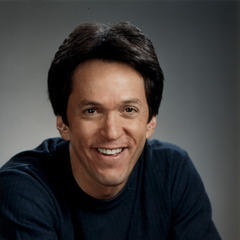
Mitch Albom
Mitch Albom

Mitch Albom, born on May 23, 1958, is a renowned American author known for his profound exploration of themes such as life, faith, and love. His works, including 'Tuesdays with Morrie' and 'For One More Day', are celebrated for their emotional depth and rich character development. more

You May Also Like

“Unfortunately, wacky ideas have dominated the public dialogue in tech to the point that important conversations about social issues have been drowned out or dismissed for years. Some of the ideas that come out of Silicon Valley include buying islands in New Zealand to prep for doomsday; seasteading, or building islands out of discarded shipping containers to create a new paradise without government or taxes; freezing cadavers so that the deceased's consciousness can be uploaded into a future robot body; creating oversized dirigibles; inventing a meal-replacement powder named after dystopian sci-fi movie Soylent Green; or making cars that fly. These ideas are certainly creative, and it's important to make space in life for dreamers–but it's equally important not to take insane ideas seriously. We should be cautious. Just because someone has made a mathematical breakthrough or made a lot of money, that doesn't mean we should listen to them when they suggest aliens are real or suggest that in the future it will be possible to reanimate people, so we should keep smart people's brains in large freezers like the ones used for frozen vegetables at Costco.”

“But there is hope. The United Nations did a study showing that small farms can feed the world. Small farms are more adaptable. They are less costly, because they don't need extremely expensive machinery, and less environmentally damaging, because they don't need to spray chemicals. And they provide greater local economic opportunities than large industrial farms do. Small farms have been proven to produce higher yields per acre and more nutrient-dense foods.”

“Towards the rear of the house lay the boot room, its cool stone floor giving away its former life as a dairy. Heavy iron hooks still hung from the beams where milk pails and cheesecloths once dangled. I relished the idea that this building had once been so much a part of the food eaten by those living within it.”

“For years after the American Revolution, the public opposed to the creation of police departments, fearing that they would become forces of repression... Only in the mid 19th century, after the growth of industrial cities and a rash of urban riots - after the dread of the so-called dangerous classes surpassed the dread of the state - did police departments emerge in the United States.”

“This is not the "relativism of truth" presented by journalistic takes on postmodernism. Rather, the ironist's cage is a state of irony by way of powerlessness and inactivity: In a world where terrorism makes cultural relativism harder and harder to defend against its critics, marauding international corporations follow fair-trade practices, increasing right-wing demagoguery and violence can't be answered in kind, and the first black U.S. president turns out to lean right of center, the intelligentsia can see no clear path of action. Irony dominates as a "mockery of the promise and fitness of things," to return to the OED definition of irony. This thinking is appropriate to Wes Anderson, whose central characters are so deeply locked in ironist cages that his films become two-hour documents of them rattling their ironist bars. Without the irony dilemma Roth describes, we would find it hard to explain figures like Max Fischer, Steve Zissou, Royal Tenenbaum, Mr. Fox, and Peter Whitman. I'm not speaking here of specific political beliefs. The characters in question aren't liberals; they may in fact, along with Anderson himself, have no particular political or philosophical interests. But they are certainly involved in a frustrated and digressive kind of irony that suggests a certain political situation. Though intensely self-absorbed and central to their films, Anderson's protagonists are neither heroes nor antiheroes. These characters are not lovable eccentrics. They are not flawed protagonists either, but are driven at least as much by their unsavory characteristics as by any moral sense. They aren't flawed figures who try to do the right thing; they don't necessarily learn from their mistakes; and we aren't asked to like them in spite of their obvious faults. Though they usually aren't interested in making good, they do set themselves some kind of mission--Anderson's films are mostly quest movies in an age that no longer believes in quests, and this gives them both an old-fashioned flavor and an air of disillusionment and futility.”

“...I take as a point of departure the possibility and desirability of a fundamentally different form of society--call it communism, if you will--in which men and women, freed from the pressures of scarcity and from the insecurity of everyday existence under capitalism, shape their own lives. Collectively they decide who, how, when, and what shall be produced.”

“To be free one must be a slave to reason. But to be a slave to reason (the very condition of freedom) exposes one to both the revisionary power and the constructive compulsion of reason. This susceptibility is terminally amplified once the commitment to the autonomy of reason and autonomous engagement with discursive practices are sufficiently elaborated. That is to say, when the autonomy of reason is understood as the automation of reason and discursive practices—the philosophical rather than classically symbolic thesis regarding artificial general intelligence.”