Quotessence
Home / Quotes / Quote by Sophocles

Quote by Sophocles

“For if any man thinks that he is alone is wise--that in speech, or in mind, he hath no peer--such a soul, when laid open, is ever found empty.”
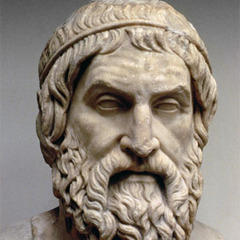
Quote by Sophocles

Work

Antigone

This renowned work explores themes of justice, morality, and the conflict between individual conscience and the state. It tells the story of Antigone, who defies the king's decree and buries her brother, leading to a series of tragic events. more

Author

Sophocles
Sophocles

Sophocles, born in 498 BC and died in 406 BC, was a renowned Greek tragic playwright. He is one of the three greatest tragic poets of ancient Greece, alongside Aeschylus and Euripides. Sophocles' works profoundly revealed the complexity of human nature and social contradictions, exerting a profound influence on subsequent drama. more

You May Also Like

“Narcissistic pleasure seekers routinely avoid developing the humility required to manufacture a life of full measure. Shallow persons such as me hide their insecurities behind a false persona of bravado, boasting of their inconsequential deeds, pyrrhic victories, and adamant refusals to tackle any task that they fear.”

“I am less to you than your ivory Hermes or your silver Faun. You will like them always. How long will you like me? Till I have my first wrinkle, I suppose. I know, now, that when one loses one's good looks, whatever they may be, one loses everything. Your picture has taught me that. Lord Henry Wotton is perfectly right. Youth is the only thing worth having. When I find that I am growing old, I shall kill myself.”

“The complacency of the individual who admires his own excellence is bad enough, but it is more respectable than the complacency of the man who has no self-esteem because he has not even a superficial self which he can esteem. He is not a person, not an individual, only an atom. This atomized existence is sometimes praised as humility or as self-sacrifice, some-times it is called obedience, sometimes it is devotion to the dialectic of class war. It produces a kind of peace which is not peace, but only the escape from an immediately urgent sense of conflict. It is the peace not of love but of anesthesia. It is the peace not of self-realization and self-dedication, but of flight into irresponsibility.”