Quotessence
Home / Quotes / Quote by Noam Chomsky

Quote by Noam Chomsky

“Now a federated, decentralised system of free associations, incorporating economic as well as other social institutions, would be what I refer to as anarcho-syndicalism; and it seems to me that this is the appropriate form of social organisation for an advanced technological society in which human beings do not have to be forced into the position of tools, of cogs in the machine. There is no longer any social necessity for human beings to be treated as mechanical elements in the productive process; that can be overcome and we must overcome it to be a society of freedom and free association, in which the creative urge that I consider intrinsic to human nature will in fact be able to realize itself in whatever way it will.”

Quote by Noam Chomsky

Author
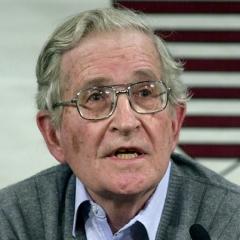
Noam Chomsky
Noam Chomsky

Noam Chomsky, born on December 7, 1928, is a renowned linguist from the United States. His research in generative grammar and transformational grammar has had a profound impact on modern linguistics. Chomsky's academic achievements extend beyond linguistics, as he is also an active political commentator and philosopher, known for his unique perspective and profound insights. more

You May Also Like

“From the start, the Left was handicapped by the great ideological differences between its constituent parts. Widest of all was the gap between the parliamentary socialist movement and the anti-parliamentary anarcho-syndicalist CNT. These differences were not a matter of voluntarism or sheer bloody-mindedness, as the standard historical narrative so often implies. Rather, their irreducibility was a result of the vastly different political, economic, and cultural experiences of the Left’s social constituencies in what was a highly unevenly developed country. For example, the direct political action favoured by many anarcho-syndicalists instantly recommended itself to the unskilled and the landless poor, whose lack of bargaining power and social defencelessness made socialist promises of gradual change through the ballot box seem immensely improbable, if not downright incredible.”

“Wherever a nucleus of organization, of fight, of production is growing, wherever wide embracing connections are tied, wherever minds are struggling for clear ideas, there foundations are laid and a start is made for the future. With partial successes won in devoted fight, through strong unity and insight progressing by gradual steps, the workers must build their new society.”

“The institutional requirements of community pose fundamental issues that neither corporate capitalism nor state socialism ever took seriously. The critical point of departure is the question: Can you have Democracy with a big D in any system if you don't have democracy with a small d in the actual experience and everyday community life of ordinary everyday citizens?”

“The fact that the state-socialist countries were backward countries desperate to catch up partly explains why it is that, instead of executing the legacy of Marx, i.e. of constructing an egalitarian, non-market society with a truly human organisation of the labour process and an end to the division of labour and the exploitation of man by man, they were actually mainly concerned with executing the legacy of Peter the Great, the Meiji Restoration and Feng Guifen.”

“In the traditional model, the dominant form of ownership is state ownership. The state owns the land and all other natural resources and all the enterprises and their productive assets. Collective ownership (e.g. the property of collective farms) also exists, but plays a subsidiary role, and is expected to be temporary. In due course, it is expected to be transformed into the higher form of state ownership.”

“Together with all this there was something of the evil atmosphere of war. The town had a gaunt untidy look, roads and buildings were in poor repair, the streets at night were dimly lit for fear of air — raids, the shops were mostly shabby and half-empty. Meat was scarce and milk practically unobtainable, there was a shortage of coal, sugar, and petrol, and a really serious shortage of bread. Even at this period the bread-queues were often hundreds of yards long. Yet so far as one could judge the people were contented and hopeful. There was no unemployment, and the price of living was still extremely low; you saw very few conspicuously destitute people, and no beggars except the gipsies. Above all, there was a belief in the revolution and the future, a feeling of having suddenly emerged into an era of equality and freedom. Human beings were trying to behave as human beings and not as cogs in the capitalist machine.”

“I mean, contrary to the contemporary version of it, classical liberalism (which remember was pre-capitalist, and in fact, anti-capitalist) focused on the right of people to control their own work, and the need for free creative work under your own control—for human freedom and creativity. So to a classical liberal, wage labor under capitalism would have been considered totally immoral, because it frustrates the fundamental need of people to control their own work: you're a slave to someone else.”

“The liberal ideals of the Enlightenment could be realized only in very partial and limited ways in the emerging capitalist order: "Democracy with its mono of equality of all citizens before the law and Liberalism with its right of man over his own person both were wrecked on the realities of capitalist economy," Rocker correctly observed. Those who are compelled to rent themselves to owners of capital in order to survive are deprived of one of the most fundamental rights: the right to productive, creative and fulfilling work under one's own control, in solidarity with others. And under the ideological constraints of capitalist democracy, the prime necessity is to satisfy the needs of those in a position to make investment decisions; if their demands are not satisfied, there will be no production, no work, no social services, no means for survival. All necessarily subordinate themselves and their interests to the overriding need to serve the interests of the owners and managers of the society, who, furthermore, with their control over resources, are easily able to shape the ideological system (the media, schools, universities and so on) in their interests, to determine the basic conditions within which the political process will function, its parameters and basic agenda, and to call upon the resources of state violence, when need be, to suppress any challenge to entrenched power. The point was formulated succinctly in the early days of the liberal democratic revolutions by John Jay, the President of the Continental Congress and the first Chief Justice of the United States Supreme Court: "The people who own the country ought to govern it." And, of course, they do, whatever political faction may be in power. Matters could hardly be otherwise when economic power is narrowly concentrated and the basic decisions over the nature and character of life, the investment decisions, are in principle removed from democratic control.”