Quotessence
Home / Quotes / Quote by Voltaire

Quote by Voltaire

“It [is] abominable for many to sow, and but few reap. On Government, Voltaire, in The Age of Enlightenment, Volume 1”

Quote by Voltaire

Author
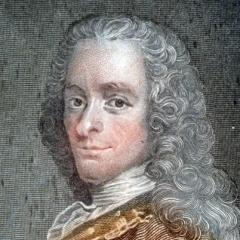
Voltaire
Voltaire

Voltaire, a French Enlightenment philosopher, writer, and thinker, was born on November 21, 1694, and died on May 30, 1778. He had a profound impact on philosophy, literature, and science in France and Europe with his sharp wit and critical spirit. more

You May Also Like

“Why, per Freedom House, is democracy now "under assault and in retreat"? Why are many people in positions of power seeking to undermine public confidence in elections, the courts, the media, and--on the fundamental question of earth's future--science? Why have such dangerous splits been allowed to develop between rich and poor, urban and rural, those with a higher education and those without? Why has the United States--at least temporarily --abdicated its leadership in world affairs? And why, this far into the twenty-first century, are we once again talking about Fascism? One reason, frankly, is Donald Trump. If we think of Fascism as a wound from the past that had almost healed, putting Trump in the White House was like ripping off the bandage and picking at the scab.”

“The defining feature of world politics post the Global Financial Crisis (GFC) has been the rise of right-wing populists, who have disrupted politics. It wasn't meant to be this way. Conventional wisdom at the time was that the GFC would lead to the 'social democratic moment'. The theory went that in the aftermath of the GFC - an event which exposed the dangers of relentless deregulation and fuelled an already existing rise of inequality - progressive parties, with a preference for appropriately calibrated regulation and redistribution, would benefit. Like much conventional wisdom, reality proved otherwise. Instead, it's been the right-wing populists' moment. The charlatans' moment. First, they disrupted their own parties, then they disrupted politics more broadly. (p.14-15)”

“Like the authors of the Manifesto, I don’t believe that the generalised mass misery of the world, all the unbearable checklists of deprivation and depravity, is irrelevant, nor unrelated to the economic system that runs the current order of things. Nor that the poverty of the poor is unrelated to the riches of the rich, nor the powerlessness of the disempowered to the power of the powerful. We’re all familiar with inventories of inequality like the one quoted above, eliciting anguish from some and eyerolling from those for whom such anguish is politically gauche. I don’t believe, for reasons outlined below, that such invidious realities are sad facts of human nature, nor that they are inevitable – though certainly changing them would not, will not, be easy. The question is whether it’s worth the attempt. Whether those countless discarded and disempowered lives are worth fighting for and alongside.”

“The encroachment on that set of rules has begun everywhere, like a parasite feeding on the edges of its host organism, because that’s what the replacement set of rules is, the old parasitic greed of the kings and their henchmen, this system we call the transnational world order is just feudalism all over again, a set of rules that is anti-ecologic, it does not give back but rather enriches a floating international elite while impoverishing everything else, and so of course the so-called rich elite are in actuality porr as well, disengaged from real human work and therefore from real human accomplishment, parasitical in the most precise sense, and yet powerful too as parasites that have taken control can be, sucking the gifts of human work away from their rightful recipients which are the seven generations, and feeding on them while increasing the repressive powers that keep them in place!”

“The last trawlers will deliver their load to those with the highest purchasing power. As the gap between high and low-income people is opening further, society's ability to react is further undermined. The reason is that influential decision-makers (who are typically in the high-income segment) are removed from the realities of overshoot. This means that our system loses necessary feedback. If those who steer society are ever more shielded from physical reality, course corrections become unlikely. Overall, the experience of many influential city dwellers is still one of expansion.”