Quotessence
Home / Quotes / Quote by Kim Stanley Robinson

Quote by Kim Stanley Robinson

“The encroachment on that set of rules has begun everywhere, like a parasite feeding on the edges of its host organism, because that’s what the replacement set of rules is, the old parasitic greed of the kings and their henchmen, this system we call the transnational world order is just feudalism all over again, a set of rules that is anti-ecologic, it does not give back but rather enriches a floating international elite while impoverishing everything else, and so of course the so-called rich elite are in actuality porr as well, disengaged from real human work and therefore from real human accomplishment, parasitical in the most precise sense, and yet powerful too as parasites that have taken control can be, sucking the gifts of human work away from their rightful recipients which are the seven generations, and feeding on them while increasing the repressive powers that keep them in place!”

Quote by Kim Stanley Robinson

Work

Red Mars

In this science fiction classic, the story follows a diverse group of individuals as they embark on a mission to establish the first human colony on Mars. The novel delves into the challenges and triumphs of this ambitious endeavor, examining the social, political, and environmental aspects of Martian colonization. more

Author
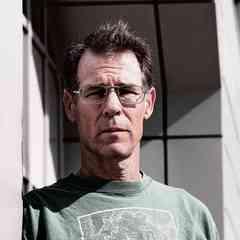
Kim Stanley Robinson

Kim Stanley Robinson is an American science fiction writer known for his profound insights into the environment, society, and the future world. His works often explore the interactions between science, technology, and social change, as well as their impact on humanity and the Earth. more

You May Also Like

“The last trawlers will deliver their load to those with the highest purchasing power. As the gap between high and low-income people is opening further, society's ability to react is further undermined. The reason is that influential decision-makers (who are typically in the high-income segment) are removed from the realities of overshoot. This means that our system loses necessary feedback. If those who steer society are ever more shielded from physical reality, course corrections become unlikely. Overall, the experience of many influential city dwellers is still one of expansion.”

“As a battle cry against feudalism, the demand for democracy had a progressive character. As time went on, however, the metaphysics of natural law (the theory of formal democracy) began to show its reactionary side – the establishment of an ideal standard to control the real demands of the laboring masses and the revolutionary parties. If we look back to the historical sequence of world concepts, the theory of natural law will prove to be a paraphrase of Christian spiritualism freed from its crude mysticism. The Gospels proclaimed to the slave that he had just the same soul as the slave-owner, and in this way established the equality of all men before the heavenly tribunal. In reality, the slave remained a slave, and obedience became for him a religious duty. In the teaching of Christianity, the slave found an expression for his own ignorant protest against his degraded condition. Side by side with the protest was also the consolation. Christianity told him, ”You have an immortal soul, although you resemble a pack-horse." Here sounded the note of indignation. But the same Christianity said, "Although you are like a pack-horse, yet your immortal soul has in store for it an eternal reward." Here is the voice of consolation. These two notes were found in historical Christianity in different proportions at different periods and amongst different classes. But as a whole, Christianity, like all other religions, became a method of deadening the consciousness of the oppressed masses. Natural law, which developed into the theory of democracy, said to the worker: "all men are equal before the law, independently of their origin, their property, and their position; every man has an equal right in determining the fate of the people." This ideal criterion revolutionized the consciousness of the masses in so far as it was a condemnation of absolutism, aristocratic privileges, and the property qualification. But the longer it went on, the more if sent the consciousness to sleep, legalizing poverty, slavery and degradation: for how could one revolt against slavery when every man has an equal right in determining the fate of the nation? Rothschild, who has coined the blood and tears of the world into the gold napoleons of his income, has one vote at the parliamentary elections. The ignorant tiller of the soil who cannot sign his name, sleeps all his life without taking his clothes off, and wanders through society like an underground mole, plays his part, however, as a trustee of the nation’s sovereignty, and is equal to Rothschild in the courts and at the elections. In the real conditions of life, in the economic process, in social relations, in their way of life, people became more and more unequal; dazzling luxury was accumulated at one pole, poverty and hopelessness at the other. But in the sphere of the legal edifice of the State, these glaring contradictions disappeared, and there penetrated thither only unsubstantial legal shadows. The landlord, the laborer, the capitalist, the proletarian, the minister, the bootblack – all are equal as "citizens" and as "legislators." The mystic equality of Christianity has taken one step down from the heavens in the shape of the "natural," "legal" equality of democracy. But it has not yet reached earth, where lie the economic foundations of society. For the ignorant day-laborer, who all his life remains a beast of burden in the service of the bourgeoisie, the ideal right to influence the fate of the nations by means of the parliamentary elections remained little more real than the palace which he was promised in the kingdom of heaven.”

“Pay attention: The ones who pay the shit tax are mostly people who were born in the wrong place and the wrong time and are hanging to the planet by their broken fingernails. They don't even know the fucking rules of the game. you can't even get mad at 'em when they lose. Life just fucks and fucks and fucks bastards like that." Kazu wrinkled his brow in resignation, like he was somewhat concerned about life's inequities but not very. He took a deep breath. "So, those losers have to climb Mount Everest to get out of hell, and maybe one or two in five thousand break out, but the rest pay the shit tax all their lives, then they die. If God exists and if He's fair, then it makes sense that in the afterlife, those guys should get the better seats.”

“Isn't this the very glue that holds the human world together? Isn't this why we need other people, to give us the pleasure of knowing we are better than they are? Amazingly, even those who seem to be the worst-off take, in their humiliation, a perverse satisfaction in the fact that no one has it worse than they do. Thus they have still, in some sense, won. Where does this all come from? Asher wonders. Can man not be repaired? If he were a machine, as some now argue, it would suffice to adjust one little lever slightly, or to tighten some small screw, and people would start to take pleasure in treating one another as equals.”

“All the problems that the socialists proposed to themselves, cosmogonic visions, reverie and mysticism being cast aside, can be reduced to two principal problems. First problem: To produce wealth. Second problem: To share it. The first problem contains the question of work. The second contains the question of salary. In the first problem the employment of forces is in question. In the second, the distribution of enjoyment. From the proper employment of forces results public power. From a good distribution of enjoyments results individual happiness. By a good distribution, not an equal but an equitable distribution must be understood. From these two things combined, the public power without, individual happiness within, results social prosperity. Social prosperity means the man happy, the citizen free, the nation great. England solves the first of these two problems. She creates wealth admirably, she divides it badly. This solution which is complete on one side only leads her fatally to two extremes: monstrous opulence, monstrous wretchedness. All enjoyments for some, all privations for the rest, that is to say, for the people; privilege, exception, monopoly, feudalism, born from toil itself. A false and dangerous situation, which sates public power or private misery, which sets the roots of the State in the sufferings of the individual. A badly constituted grandeur in which are combined all the material elements and into which no moral element enters. Communism and agrarian law think that they solve the second problem. They are mistaken. Their division kills production. Equal partition abolishes emulation; and consequently labor. It is a partition made by the butcher, which kills that which it divides. It is therefore impossible to pause over these pretended solutions. Slaying wealth is not the same thing as dividing it. The two problems require to be solved together, to be well solved. The two problems must be combined and made but one.”