“A proof represents a logical process which has come to a definitive conclusion in a finite number of stages. However, a logical machine following definite rules need never come to a conclusion. It may go on grinding through different stages without ever coming to a stop, either by describing a pattern of activity of continually increasing complexity, or by going into a repetitive process like the end of a chess game in which there is a continuing cycle of perpetual check. This occurs in the case of some of the paradoxes of Cantor and Russell. Let us consider the class of all classes which are not members of themselves. Is this class a member of itself? If it is, it is certainly not a member of itself; and if it is not, it is equally certainly a member of itself. A machine to answer this question would give the successive temporary answers: “yes,” “no,” “yes,” “no,” and so on, and would never come to equilibrium. Bertrand Russell’s solution of his own paradoxes was to affix to every statement a quantity, the so-called type, which serves to distinguish between what seems to be formally the same statement, according to the character of the objects with which it concerns itself—whether these are “things,” in the simplest sense, classes of “things,” classes of classes of “things,” etc. The method by which we resolve the paradoxes is also to attach a parameter to each statement, this parameter being the time at which it is asserted. In both cases, we introduce what we may call a parameter of uniformization, to resolve an ambiguity which is simply due to its neglect.”
Quote by Norbert Wiener
Work
Cybernetics: or the Control and Communication in the Animal and the Machine
Browse quotes and source details for this work. more
Author
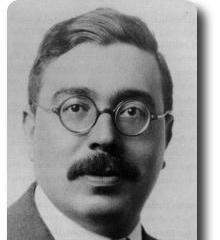
Norbert Wiener
Norbert Wiener, born on November 26, 1894, and died on March 18, 1964, was an American mathematician and a founding figure in the field of cybernetics. Known as the 'father of the information age,' Wiener made significant contributions to mathematics, physics, and engineering, particularly in the areas of stochastic processes, Fourier analysis, and control theory. more
You May Also Like
Source: The Bridges Of Madison County
Source: A Good Girl's Guide to Murder
Source: Principles: Life and Work
“English: "Means are limit of consequences." Česky: „Prostředky jsou limitem následků.”
Source: Vtiposcifilo-z/s-ofie
“One who has reason has something, one who has heart has everything.”
Source: Bulldozer on Duty
Source: Catch the Rabbit
“God is a circle whose center is everywhere, and its circumference nowhere.”
Source: Empedocles: The Extant Fragments
“Illogical person + silence = smartness”
Source: Quantraz
“Logical person + logical person = new perspective.”
Source: Quantraz