Quotessence
Home / Quotes / Quote by Sun Tzu

Quote by Sun Tzu

“If, on the other hand, in the midst of difficulties we are always ready to seize an advantage, we may extricate ourselves from misfortune.”

Quote by Sun Tzu

Work

The Art of War

This seminal work explores the principles of warfare, leadership, and conflict resolution, offering timeless insights into the nature of power and the art of winning battles without resorting to brute force. more
Author

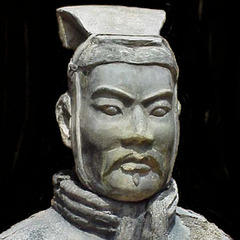
Sun Tzu
Sun Tzu

Sun Tzu, born around 544 BC and died around 496 BC, was a renowned Chinese military strategist. His military thoughts are mainly reflected in his book 'The Art of War', which is considered the classic of military strategy and has had a profound impact on various fields such as military, politics, and economics in later generations. more

You May Also Like

“But I am well aware of the excuse which men, ever ingenious in devising mischief to themselves as well as others, offer in extenuation of their conduct in going to war. They allege, that they are compelled to it; that they are dragged against their will to war. I answer them, deal fairly; pull off the mask; throw away all false colours; consult your own heart, and you will find that anger, ambition, and folly are the compulsory force that has dragged you to war, and not any necessity; unless indeed you call the insatiable cravings of a covetous mind, necessity" ` The Complaint of Peace”

“The future says: Dear mortals; I know you are busy with your colourful lives; I have no wish to waste the little time that remains On arguments and heated debates; But before I can appear Please, close your eyes, sit still And listen carefully To what I am about to say; I haven't happened yet, but I will. I can't pretend it's going to be Business as usual. Things are going to change. I'm going to be unrecognisable. Please, don't open your eyes, not yet. I'm not trying to frighten you. All I ask is that you think of me Not as a wish or a nightmare, but as a story You have to tell yourselves - Not with an ending In which everyone lives happily ever after, Or a B-movie apocalypse, But maybe starting with the line 'To be continued...' And see what happens next. Remember this; I am not Written in stone But in time - So please don't shrug and say What can we do? It's too late, etc, etc, etc. Dear mortals, You are such strange creatures With your greed and your kindness, And your hearts like broken toys; You carry fear with you everywhere Like a tiny god In its box of shadows. You love festivals and music And good food. You lie to yourselves Because you're afraid of the dark. But the truth is: you are in my hands And I am in yours. We are in this together, Face to face and eye to eye; We're made for each other. Now those of you who are still here; Open your eyes and tell me what you see.”

“The men digging in on both sides of me cursed the stench and the mud. I began moving the heavy, sticky clay mud with my entrenching shovel to shape out the extent of the foxhole before digging deeper. Each shovelful had to be knocked off the spade, because it stuck like glue. I was thoroughly exhausted and thought my strength wouldn’t last from one sticky shovelful to the next. Kneeling on the mud, I had dug the hole no more than six or eight inches deep when the odor of rotting flesh got worse. There was nothing to do but continue to dig, so I closed up my mouth and inhaled with short shallow breaths. Another spadeful of soil out of the hole released a mass of wriggling maggots that came welling up as though those beneath were pushing them out. I cursed and told the NCO as he came by what a mess I was digging into. ‘You heard him, he said put the holes five yards apart.’ In disgust, I drove the spade into the soil, scooped out the insects, and threw them down the front of the ridge. The next stroke of the spade unearthed buttons and scraps of cloth from a Japanese army jacket in the mud—and another mass of maggots. I kept on doggedly. With the next thrust, metal hit the breastbone of a rotting Japanese corpse. I gazed down in horror and disbelief as the metal scraped a clean track through the mud along the dirty whitish bone and cartilage with ribs attached. The shoved skidded into the rotting abdomen with a squishing sound. The odor nearly overwhelmed me as I rocked back on my heels. I began choking and gagging as I yelled in desperation, ‘I can’t dig in here! There’s a dead Nip here!’ The NCO came over, looked down at my problem and at me, and growled, ‘You heard him; he said put the holes five yards apart.”

“Nothing remains.  The destruction is complete: love, lives, families, friends, cities, homes – all gone now.  All our efforts to be good, to do the right thing, to act well, to be just and generous are now for naught.  Because juxtaposed against any hope for fairness is wickedness, pure and simple.  In some abstract formulation these things may exist in equal measure, which is to say that the scales balance when taking all things into consideration. But that is fantasy, the stuff of religion, hope beyond all reason. Because for those caught in the whirlwind, in the chaos of manifest evil, despair is all there is. Civilization falls away: everything is pointless now.  Survival requires reciprocity. What then if there is none?”

“I am an absurd idealist. But I believe that all that must come true. For, unless it comes true, the world will be laid desolate. And I believe that it can come true. I believe that, by the grace of God, men will awake presently and be men again, and colour and laughter and splendid living will return to a grey civilisation. But that will only come true because a few men will believe in it, and fight for it, and fight in its name against everything that sneers and snarls at that ideal.”

“It is the story that lies around the edges of the photographs, or at the end of newspaper account. It's about the lies we tell others to protect them, and about the lies we tell ourselves in order not to acknowledge what we can't bear: that we are alive, for instance, and eating lunch, while bombs are falling, and refugees are crammed into camps, and the news comes toward us every hour of the day. And what, in the end, do we do?”