Quotessence
Home / Quotes / Quote by Leslie Charteris

Quote by Leslie Charteris

“I am an absurd idealist. But I believe that all that must come true. For, unless it comes true, the world will be laid desolate. And I believe that it can come true. I believe that, by the grace of God, men will awake presently and be men again, and colour and laughter and splendid living will return to a grey civilisation. But that will only come true because a few men will believe in it, and fight for it, and fight in its name against everything that sneers and snarls at that ideal.”

Quote by Leslie Charteris

Work

The Last Hero

This book follows the story of a protagonist who embodies the last of a legendary hero class, facing the end of an era and the challenges of a changing world. more

Author

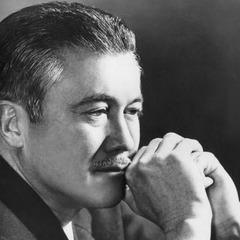
Leslie Charteris
Leslie Charteris

Leslie Charteris was a British author born on May 12, 1907, in Johannesburg, South Africa, and passed away on April 15, 1993, in the United Kingdom. He is best known for his detective novels, with his most famous work being the series about The Saint, a wealthy and clever adventurer who often battles criminals. more

You May Also Like

“It is the story that lies around the edges of the photographs, or at the end of newspaper account. It's about the lies we tell others to protect them, and about the lies we tell ourselves in order not to acknowledge what we can't bear: that we are alive, for instance, and eating lunch, while bombs are falling, and refugees are crammed into camps, and the news comes toward us every hour of the day. And what, in the end, do we do?”

“But what I would like to know," says Albert, "is whether there would not have been a war if the Kaiser had said No." "I'm sure there would," I interject, "he was against it from the first." "Well, if not him alone, then perhaps if twenty or thirty people in the world had said No." "That's probable," I agree, "but they damned well said Yes." "It's queer, when one thinks about it," goes on Kropp, "we are here to protect our fatherland. And the French are over there to protect their fatherland. Now who's in the right?" "Perhaps both," say I without believing it. "Yes, well now," pursues Albert, and I see that he means to drive me into a corner, "but our professors and parsons and newspapers say that we are the only ones that are right, and let's hope so;--but the French professors and parsons and newspapers say that the right is on their side, now what about that?" "That I don't know," I say, "but whichever way it is there's war all the same and every month more countries coming in." Tjaden reappears. He is still quite excited and again joins the conversation, wondering just how a war gets started. "Mostly by one country badly offending another," answers Albert with a slight air of superiority. Then Tjaden pretends to be obtuse. "A country? I don't follow. A mountain in Germany cannot offend a mountain in France. Or a river, or a wood, or a field of wheat." "Are you really as stupid as that, or are you just pulling my leg?" growls Kropp, "I don't mean that at all. One people offends the other--" "Then I haven't any business here at all," replies Tjaden, "I don't feel myself offended." "Well, let me tell you," says Albert sourly, "it doesn't apply to tramps like you." "Then I can be going home right away," retorts Tjaden, and we all laugh, "Ach, man! he means the people as a whole, the State--" exclaims Mller. "State, State"--Tjaden snaps his fingers contemptuously, "Gendarmes, police, taxes, that's your State;--if that's what you are talking about, no, thank you." "That's right," says Kat, "you've said something for once, Tjaden. State and home-country, there's a big difference." "But they go together," insists Kropp, "without the State there wouldn't be any home-country." "True, but just you consider, almost all of us are simple folk. And in France, too, the majority of men are labourers, workmen, or poor clerks. Now just why would a French blacksmith or a French shoemaker want to attack us? No, it is merely the rulers. I had never seen a Frenchman before I came here, and it will be just the same with the majority of Frenchmen as regards us. They weren't asked about it any more than we were." "Then what exactly is the war for?" asks Tjaden. Kat shrugs his shoulders. "There must be some people to whom the war is useful." "Well, I'm not one of them," grins Tjaden. "Not you, nor anybody else here." "Who are they then?" persists Tjaden. "It isn't any use to the Kaiser either. He has everything he can want already." "I'm not so sure about that," contradicts Kat, "he has not had a war up till now. And every full-grown emperor requires at least one war, otherwise he would not become famous. You look in your school books." "And generals too," adds Detering, "they become famous through war." "Even more famous than emperors," adds Kat. "There are other people back behind there who profit by the war, that's certain," growls Detering. "I think it is more of a kind of fever," says Albert. "No one in particular wants it, and then all at once there it is. We didn't want the war, the others say the same thing--and yet half the world is in it all the same.”

“Surely the Board knows what democracy is. It is the line that forms on the right. It is the don’t in Don’t Shove. It is the hole in the stuffed shirt through which the sawdust slowly trickles; it is the dent in the high hat. Democracy is the recurrent suspicion that more than half the people are right more than half the time. It is the feeling of privacy in the voting booths, the feeling of communion in the libraries, the feeling of vitality everywhere. Democracy is the score at the beginning of the ninth. It is an idea which hasn’t been disproved yet, a song the words of which have not gone bad. It’s the mustard on the hot dog and the cream in the rationed coffee. Democracy is a request from a War Board, in the middle of a morning in the middle of a war, wanting to know what democracy is.”