Quotessence
Home / Quotes / Quote by Eugene B. Sledge

Quote by Eugene B. Sledge

“The men digging in on both sides of me cursed the stench and the mud. I began moving the heavy, sticky clay mud with my entrenching shovel to shape out the extent of the foxhole before digging deeper. Each shovelful had to be knocked off the spade, because it stuck like glue. I was thoroughly exhausted and thought my strength wouldn’t last from one sticky shovelful to the next. Kneeling on the mud, I had dug the hole no more than six or eight inches deep when the odor of rotting flesh got worse. There was nothing to do but continue to dig, so I closed up my mouth and inhaled with short shallow breaths. Another spadeful of soil out of the hole released a mass of wriggling maggots that came welling up as though those beneath were pushing them out. I cursed and told the NCO as he came by what a mess I was digging into. ‘You heard him, he said put the holes five yards apart.’ In disgust, I drove the spade into the soil, scooped out the insects, and threw them down the front of the ridge. The next stroke of the spade unearthed buttons and scraps of cloth from a Japanese army jacket in the mud—and another mass of maggots. I kept on doggedly. With the next thrust, metal hit the breastbone of a rotting Japanese corpse. I gazed down in horror and disbelief as the metal scraped a clean track through the mud along the dirty whitish bone and cartilage with ribs attached. The shoved skidded into the rotting abdomen with a squishing sound. The odor nearly overwhelmed me as I rocked back on my heels. I began choking and gagging as I yelled in desperation, ‘I can’t dig in here! There’s a dead Nip here!’ The NCO came over, looked down at my problem and at me, and growled, ‘You heard him; he said put the holes five yards apart.”

Quote by Eugene B. Sledge

Work

With the Old Breed: At Peleliu and Okinawa

Browse quotes and source details for this work. more

Author
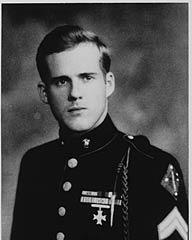
Eugene B. Sledge
Eugene B. Sledge

Eugene B. Sledge, born on November 4, 1923, was an American author known for his works centered around his experiences during World War II, particularly in the Pacific Theater. His writing, characterized by its raw and vivid depiction of war, has won him a wide readership. His most famous work, 'With the Old Breed: At Peleliu and Okinawa', offers a detailed account of his time in the battlefield, providing a poignant glimpse into the harsh realities of war and the bravery of soldiers. more

You May Also Like

“Nothing remains.  The destruction is complete: love, lives, families, friends, cities, homes – all gone now.  All our efforts to be good, to do the right thing, to act well, to be just and generous are now for naught.  Because juxtaposed against any hope for fairness is wickedness, pure and simple.  In some abstract formulation these things may exist in equal measure, which is to say that the scales balance when taking all things into consideration. But that is fantasy, the stuff of religion, hope beyond all reason. Because for those caught in the whirlwind, in the chaos of manifest evil, despair is all there is. Civilization falls away: everything is pointless now.  Survival requires reciprocity. What then if there is none?”

“I am an absurd idealist. But I believe that all that must come true. For, unless it comes true, the world will be laid desolate. And I believe that it can come true. I believe that, by the grace of God, men will awake presently and be men again, and colour and laughter and splendid living will return to a grey civilisation. But that will only come true because a few men will believe in it, and fight for it, and fight in its name against everything that sneers and snarls at that ideal.”

“It is the story that lies around the edges of the photographs, or at the end of newspaper account. It's about the lies we tell others to protect them, and about the lies we tell ourselves in order not to acknowledge what we can't bear: that we are alive, for instance, and eating lunch, while bombs are falling, and refugees are crammed into camps, and the news comes toward us every hour of the day. And what, in the end, do we do?”

“But what I would like to know," says Albert, "is whether there would not have been a war if the Kaiser had said No." "I'm sure there would," I interject, "he was against it from the first." "Well, if not him alone, then perhaps if twenty or thirty people in the world had said No." "That's probable," I agree, "but they damned well said Yes." "It's queer, when one thinks about it," goes on Kropp, "we are here to protect our fatherland. And the French are over there to protect their fatherland. Now who's in the right?" "Perhaps both," say I without believing it. "Yes, well now," pursues Albert, and I see that he means to drive me into a corner, "but our professors and parsons and newspapers say that we are the only ones that are right, and let's hope so;--but the French professors and parsons and newspapers say that the right is on their side, now what about that?" "That I don't know," I say, "but whichever way it is there's war all the same and every month more countries coming in." Tjaden reappears. He is still quite excited and again joins the conversation, wondering just how a war gets started. "Mostly by one country badly offending another," answers Albert with a slight air of superiority. Then Tjaden pretends to be obtuse. "A country? I don't follow. A mountain in Germany cannot offend a mountain in France. Or a river, or a wood, or a field of wheat." "Are you really as stupid as that, or are you just pulling my leg?" growls Kropp, "I don't mean that at all. One people offends the other--" "Then I haven't any business here at all," replies Tjaden, "I don't feel myself offended." "Well, let me tell you," says Albert sourly, "it doesn't apply to tramps like you." "Then I can be going home right away," retorts Tjaden, and we all laugh, "Ach, man! he means the people as a whole, the State--" exclaims Mller. "State, State"--Tjaden snaps his fingers contemptuously, "Gendarmes, police, taxes, that's your State;--if that's what you are talking about, no, thank you." "That's right," says Kat, "you've said something for once, Tjaden. State and home-country, there's a big difference." "But they go together," insists Kropp, "without the State there wouldn't be any home-country." "True, but just you consider, almost all of us are simple folk. And in France, too, the majority of men are labourers, workmen, or poor clerks. Now just why would a French blacksmith or a French shoemaker want to attack us? No, it is merely the rulers. I had never seen a Frenchman before I came here, and it will be just the same with the majority of Frenchmen as regards us. They weren't asked about it any more than we were." "Then what exactly is the war for?" asks Tjaden. Kat shrugs his shoulders. "There must be some people to whom the war is useful." "Well, I'm not one of them," grins Tjaden. "Not you, nor anybody else here." "Who are they then?" persists Tjaden. "It isn't any use to the Kaiser either. He has everything he can want already." "I'm not so sure about that," contradicts Kat, "he has not had a war up till now. And every full-grown emperor requires at least one war, otherwise he would not become famous. You look in your school books." "And generals too," adds Detering, "they become famous through war." "Even more famous than emperors," adds Kat. "There are other people back behind there who profit by the war, that's certain," growls Detering. "I think it is more of a kind of fever," says Albert. "No one in particular wants it, and then all at once there it is. We didn't want the war, the others say the same thing--and yet half the world is in it all the same.”