Quotessence
Home / Quotes / Quote by Ulysses S. Grant

Quote by Ulysses S. Grant

“For centuries England has relied on protection, has carried it to extremes, and has obtained satisfactory results from it. There is no doubt that it is to this system that it owes its present strength. After two centuries, England has found it convenient to adopt free trade because it thinks that protection can no longer offer it anything. Very well then, gentlemen, my knowledge of our country leads me to believe that within two hundred years, when America has gotten out of protection all that it can offer, it too will adopt free trade.”

Quote by Ulysses S. Grant

Author
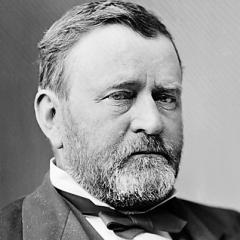
Ulysses S. Grant
Ulysses S. Grant

Ulysses S. Grant was the 18th President of the United States, renowned for his military prowess during the Civil War. He served as the commander-in-chief of the Union Army and played a crucial role in the Northern victory. During his presidency, Grant focused on rebuilding the South and promoting a series of reforms. His leadership style and policy initiatives had a profound impact both during his time and in subsequent history. more

You May Also Like

“Dr. Wickramsinghe, I don't mean to insult, but what do we have in Sri Lanka? We have a small island nation the size of what, Belgium, that has been at war with itself since 1983. A sixteen-year civil war which shows no signs of abating. A tiny poor nation. What do you possibly have to offer anyone besides warmed-over wage slaves and more of the same?" ..."Listen, we support development. But there are some serious problems with the Sri Lankan way of life. I can assure you that there will be no entry into the WTO for Sri Lanka, nor any free trade agreements with the U.S., unless you enact some serious reforms. Tighten your fucking belt. I believe we have made it very clear that your grossly overfunded health and education will have to go.”

“A man must find time for himself. Time is what we spend our lives with. If we are not careful we find others spending it for us. . . . It is necessary now and then for a man to go away by himself and experience loneliness; to sit on a rock in the forest and to ask of himself, 'Who am I, and where have I been, and where am I going?' . . . If one is not careful, one allows diversions to take up one's time—the stuff of life.”

“As long as we lean on anything outside ourselves for support, we are going to be insecure. Most of us try to find support by leaning on all sorts of things - gold, books, learning, sensory stimulation - and if these things are taken away, we fall over. To the extent that we are dependent on these external supports, we grow weaker and more liable to upsets and misfortune.”

“Page 199: According to the U.S. Bureau of Economic Statistics, more than 20 percent of all imports to the United States come from foreign subsidiaries or affiliates of U.S. multinational corporations. … This is why American business is so adamantly opposed to tariffs—not fear of foreign retaliation, but fear of tariffs on products from American-owned industrial plantations.”

“Page 200: This school of thought might be called “free trade plus.” The United States will benefit from global free trade, these liberals argue, as long as the skills and productivity of American workers are upgraded. Higher skills translate into higher productivity, which will in turn translate into higher wages. Here a good theory falls victim to an evil fact: productivity has been going up in America, without resulting wage gains for American workers. The average productivity of American workers increased by more than 30 percent between 1977 and 1992, while the average real wage fell by 13 percent.”

“Page 204: In an 1848 address, he (Karl Marx) observed: "Generally speaking, the Protective system in these days is conservative, while the Free Trade system works destructively. It breaks up old nationalities and carries antagonism of proletariat and bourgeoisie to the uttermost point. In a work, the Free Trade system hastens the Social Revolution. In this revolutionary sense alone, gentlemen, I am in favor of Free Trade." … the neo-fascist right is more likely than the cosmopolitan left to benefit from erosion of living standards by free-market globalism. Laissez-faire globalism may breed its own nemesis, in the form of the most radical and destructive kinds of ethnic nationalism and economic statism.”

“Quoting page 99-101: The opening of unregulated foreign trade causes a general shift of production and jobs to the low-wage nations. They experience a rapid rise in production of advanced goods and in the availability of skill-developing and high-paid jobs, rapidly build new factories, and experience a rapid upgrading in their jobs, economic capabilities, and income. The other side of these benefits to the low-income nations is the corresponding damage to the high-income nations, that are losing the industries and jobs that these nations are gaining. The high-income nations experience an excess of imports over exports, a decline in production of advanced goods and in the availability of skill-developing and high-paid jobs, suffer a decline and obsolescence in their industrial plant, and a downgrading in their available jobs, economic capabilities, and income. This pattern of trade is anomalous not only because it calls on the high-income nations to acquiesce in their own economic decline, but because it points toward a world-wide failure or collapse. The low-income nations are betting their futures on continued increases in sales of advanced goods in the markets of the high-income nations--but these markets are being undermined by the economic decline of the high-income nations. If the low-income nations have a very large population, and especially if any of the nations in the unregulated-trade group have rapid rates of population-growth, the end result of the process will be that there will be no high-income nations anywhere and no substantial market for advanced goods. In the end, all nations are dragged down. The rise in the low-income nations cannot be extrapolated into the future, for it destroys the conditions by which it is temporarily supported. ... The final effects on the standard of living of the high-income nation of unregulated foreign trade are similar to the effects of its permitting unlimited immigration. The shifting of the jobs to the low-wage nation has the same effects as the shifting of excessive numbers of workers to the high-wage nation.”

“[The right-wing populist] narrative centres around division: dividing the world into the virtuous and non-virtuous. Convincing an electoral majority that they are among the virtuous, and that the non-virtuous - that is, free trade, China, migrants and refugees, and those who would impose meaningful action on climate change - need to be dealt with via tough policies. This right-wing populism turbocharges identity and grievance politics and weaponises it through the amplifying support of both social media and elements of the traditional mainstream media. (p.20-21)”