Quotessence
Home / Quotes / Quote by P. G. Wodehouse

Quote by P. G. Wodehouse

“There are situations in life which are beyond one. The sensible man realizes this, and slides out of such situations, admitting himself beaten. Others try to grapple with them, but it never does any good. When affairs get in a real tangle, it is best to sit still and let them straighten themselves out. Or, if one does not do that, simply to think no more about them. This is Philosophy. The true philosopher is the man who says "All right," and goes to sleep in his arm-chair. One's attitude towards Life's Little Difficulties should be that of the gentleman in the fable, who sat down on an acorn one day and happened to doze. The warmth of his body caused the acorn to germinate, and it grew so rapidly that, when he awoke, he found himself sitting in the fork of an oak sixty feet from the ground. He thought he would go home, but, finding this impossible, he altered his plans. "Well, well," he said, "if I cannot compel circumstances to my will, I can at least adapt my will to circumstances. I decide to remain here." Which he did, and had a not unpleasant time. The oak lacked some of the comforts of home, but the air was splendid and the view excellent. Today's Great Thought for Young Readers. Imitate this man.”

Quote by P. G. Wodehouse

Author
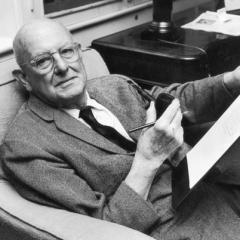
P. G. Wodehouse
P. G. Wodehouse

P. G. Wodehouse was a British writer, humorist, and composer, renowned for his humorous stories and novels, especially those featuring the characters Jeeves and Bertie Wooster. His works have been translated into many languages and have had a lasting impact on generations of readers. more

You May Also Like

“The ability to remain constant, whole and playful, even while working technically, concentrating and upholding urgency, is essential to achieve a state of balance that will allow for this to happen. This has to come to life, and cannot stay just an idea or hope or intention or imitation, or ignored. The guarantee and proof that this balance and power is real is in its actualization. That is, that it manifests in functional reality. As in any intention, whether that be vague or specific, an ambition or desire, a goal or state of being, a question or hope, a curiosity or purpose, there exist natural and unnatural obstacles to its realization.”

“Sometimes I wonder how much of our suffering we allow or impose on ourselves simply in search of our worthiness to accept our own respect and appreciation.”

“Sometimes we don't want to be tethered to yesterday. It's nicer to forget. Maybe the gaps in our memory are there for a reason, evolutionary perhaps, to give us the space to grow, to get away from childishness or childish things. Or maybe it's so we have the chance to invent, or at least include, some magic in our yesterdays, surely the consolation of getting older, of moving away from youth, is that we can shape our past to our fantasies. So, even if the present isn't going the way we want it, we can stand and remember our earlier selves as exciting and funny and daring”

“I write romance stories and although I want it to be a beautiful work of art, I am afraid that I will live in the story I created in my mind. It's all in my mind I know, but sometimes, the romance becomes too ideal and realistic for me that I soon fall for the hero that was just a product of my imagination. I think that is both an fearful obstacle and a proof that somehow, you are succeeding to touch a reader's heart - even if it is yours.”

“Life will give you what you need once you will do something with it. It may not give you what you want so as to be as comfortable as you want, as Nature’s concern is need as it relates to evolution. In my humble opinion, Nature is too kind, but, as I say, the game is big, and the challenges and temptations absolute. And this is a fascinating aspect of the totality of beauty; it gives more than is only necessary. The generosity is mind- and heart boggling.”

“Sometimes I wonder how much of our suffering we allow or impose on ourselves simply in search of our worthiness to accept our own respect and appreciation. I’d written before some years ago that we often cause suffering in another so that we can then love them, as in, “You have suffered for me, so I can love you now.” The eventual shock of realizing the sacrifice made for you destroys the walls of self-righteousness and protection. The suffering sacrifice of another creates the willingness and capacity to do the same. Finally, love and respect (respect is part of the body of love) come from the recognition of something else already given up for them. Within the individual, you or me, a similar process takes place toward oneself. It is as if we know some- where that we are not worthy of our own love or respect until we have earned the right to it, and that is mainly through some kind of suffering. That suffering may be generic, as in a life lived in which tragedy after tragedy accumulate, or it may be specific, as in the constant sacrifice of other easier things for a being or vision. Or, perhaps more correctly, it is either consciously chosen or not.”

“One could make a nice link between imagination and spirit. To make that link, all we need is some inspiration. Essentially, imagination has the innate potential to compel or inspire and to set in motion causation. That’s why it exists.”

“Preceding the birth of every religion, there was someone who was an incarnation of this process: imagination causes inspiration causes intuition causes beauty, which causes imagination…the dynamic that takes place in the dimension of spirit. That is, for whatever reasons that will remain mysterious, although they are suggested in various schools of thought, someone got the cause thing down right, and the rest flowed. After the fact, an effort was made, almost always by others, to control both the impact of this and the possible benefits from it. Ambition and desire took over. Where you had an exact presentation, or manifestation, of beauty and truth, somebody began using it for other purposes.”