Quotessence
Home / Quotes / Quote by Karl Popper

Quote by Karl Popper

“The belief in causality is metaphysical. It is nothing but a typical metaphysical hypostatization of a well-justified methodological rule- the scientist's decision never to abandon his search for laws. The metaphysical belief in causality seems thus more fertile in its various manifestations than any indeterminist physics metaphysics of the kind advocated by Heisenberg. Indeed, we can see that Heisenberg's comments have had a crippling effect on research. Connections which are not far to seek may easily be overlooked if its continually repeated that the search for any such connections is 'meaningless'.”

Quote by Karl Popper

Work

The Logic of Scientific Discovery

This book delves into the nature of scientific knowledge, examining the methods and criteria that distinguish scientific theories from other forms of knowledge. It discusses the role of empirical evidence, the structure of scientific theories, and the process of scientific discovery. more

Author
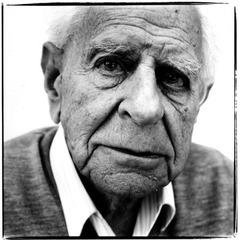
Karl Popper
Karl Popper

Karl Popper (July 28, 1902 – September 17, 1994) was an influential philosopher known for his work on critical rationalism and falsificationism. He is renowned for his contributions to the philosophy of science, political philosophy, and epistemology, with his ideas having a profound impact on these fields. more

You May Also Like

“There is no such thing as randomness. No one who could detect every force operating on a pair of dice would ever play dice games, because there would never be any doubt about the outcome. The randomness, such as it is, applies to our ignorance of the possible outcomes. It doesn’t apply to the outcomes themselves. They are 100% determined and are not random in the slightest. Scientists have become so confused by this that they now imagine that things really do happen randomly, i.e. for no reason at all.”

“No random event has ever been empirically demonstrated. Events have been observed which have been interpreted as being based on randomness, but this is merely an inference, and rationalists can advance totally different inferences that never once refer to randomness.”

“Wavefunction collapse is anything other than “random”. If you could really see what was going on, you would see that nothing ever happens randomly, any more than a dice throw produces a genuinely randomly outcome (if you could see what was going on, all the forces in play, you would know exactly what the outcome would be). Sensory ignorance is not ontological uncertainty. Reality knows exactly what it is doing even if you don’t!”

“It’s actually funny that science lays claim to randomness since no one has ever seen a random event. Scientists interpret events as random rather than causal because of their dogmatic ideology. Their paradigm forbids them from referring to unobservable causal processes – implying a reality more fundamental than science which science cannot penetrate – but accepts randomness, as the least threat to science’s supremacy, even though, in Hume’s terms, randomness is no more empirical than causation, hence no more scientifically valid, and infinitely less rational!”

“Resistance to change in the mental health system comes disguised as protection of civil liberties and freedom of speech. As a result, many parents, families, and caregivers are at a loss and feel defeated by the majority of Americans who strive to maintain the current rules of society.”

“But the question is, historically, part of the group that you're a part of - whether it's racial, gender, religious, whatever - how has your group fared historically? The groups that you're a part of? Like, for me, as an atheist, Jew, I'm gonna go on, uh - oh and Emma Goldman is one of my great heroes and I really think that anarchism is a fantastic principle by which to fashion a utopian society even if we can't get there. Like historically, that does not go well.”

“Man has bought brains, but all the millions in the world have failed to buy love. Man has subdued bodies, but all the power on earth has been unable to subdue love. Man has conquered whole nations, but all his armies could not conquer love. …Love has the magic power to make of a beggar a king. Yes, love is free; it can dwell in no other atmosphere. In freedom it gives itself unreservedly, abundantly, completely.”

“The pages of the magazine Mother Earth that Emma Goldman edited from 1906 to 1917 are filled with Yiddish stories, tales from the Talmud, and translations of Morris Rosenfeld’s poetry. Moreover, her commitment to anarchism did not divert her from speaking and writing, openly and frequently, about the particular burdens Jews faced in a world in which antisemitism was a living enemy. Apparently, Emma Goldman’s faith in anarchism, with its emphasis on universalism, did not result from and was not dependent on a casting off of Jewish identity.”