Quotessence
Home / Quotes / Quote by Simone de Beauvoir

Quote by Simone de Beauvoir

“I cannot withdraw into myself. I exist, outside myself and everywhere in the world. There is not an inch of my path which does not encroach on the path of another: there is no way of being that can prevent me from overflowing myself at every moment. This life that I weave with my own substance, it offers other men a thousand unknown faces, it crosses impetuously their fate.”

Quote by Simone de Beauvoir

Work

The Blood of Others

Browse quotes and source details for this work. more

Author

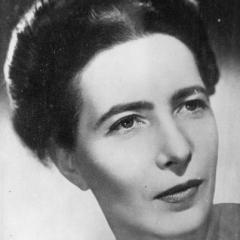
Simone de Beauvoir
Simone de Beauvoir

Simone de Beauvoir was a French writer, philosopher, feminist, and social activist. Known for her profound philosophical thoughts and her advocacy for women's status, she is one of the most influential female thinkers of the 20th century. Her works spanned various genres, including novels, philosophical essays, plays, and memoirs, with her most famous work being 'The Second Sex'. more

You May Also Like

“Can a person crave to destroy himself and at the same time wish to transmute himself into a fuller being? Is destruction of a central part of us necessary in order to transform ourselves? How do perceptive people fend off their destructive impulses, through insensibility or with greatness of mind? How can an ordinary person such as me, deficient in natural talent and ignorant in the ways of the world, blunt the self-doubt and the fear that nips at my heels? How does a vegetative character such as me express the vivacity of life while counterbalancing the immutable sorrows that accompany our struggles to glean meaning in life? How does anyone function rationally knowing that his or her life will ruefully end with death?”

“The root of faults is nothing other than your ego-clinging, the attitude of deluded fixation, so cut the ties of ego-clinging! Cast away the fixation on enemy and friend! Forsake worldly concerns! Abandon materialistic pursuits! Engage in nothing but the Dharma from the core of your heart! Just as a seedling doesn't grow on a stone, there will be no enhancement without removing the fault of ego-clinging. You should therefore abandon the root of all evils, ego-clinging. (p. 90)”

“Movement offers us pleasure, identity, belonging and hope. It puts us in places that are good for us, whether that's outdoors in nature, in an environment that challenges us, or with a supportive community. It allows us to redefine ourselves and reimagine what is possible. It makes social connection easier and self-transcendence possible. Each of these benefits can be realized through other means. There are multiple paths to discovery and many ways to build community. Happiness can be found in any number of roles and pastimes; solace can be taken in poetry, prayer or art. Exercise need not replace any of these other sources of meaning and joy. Yet physical activity stands out in its ability to fulfill so many human needs, and that makes it worth considering as a fundamentally valuable endeavour. It is as if what is good in us is most easily activated or accessed through movement. As rower Kimberley Sogge put it, when she described to me why the Head of the Charles Regatta was such a peak experience, "The highest spirit of humanity gets to come out." Ethicist Sigmund Loland came to a similar conclusion, declaring that an exercise pill would be a poor substitute for physical activity. As he wrote, "Rejecting exercise means rejecting significant experiences of being human.”

“Traditional marriage understood this, and its most enlightened response to this difficulty was to treat these frustrations and disappointments as an opportunity to self-transcend: "Your wife no longer has sex with you? Excellent! Use your involuntary celibacy as a chance to examine your own carnal attachment. Your kids leave you no time for yourself? Wonderful. Use your maternal responsibility as a means to overcome your residual selfishness. You're no longer satisfied with your relationship?Phenomenal. Use your dissatisfaction as an opportunity to realize you are entitled to absolutely nothing in this life. And this perspective isn't necessarily wrong. Marriage did demand that people self-transcend - at least as long as they couldn't get out of it. And while it may not have been exactly what people wanted - the argument could be made that it might just have been what people needed in order to mature into fully functional adults. The issue is that willingly entering into difficulty because it can be used as an opportunity for growth is about as appealing to most people as running a marathon on their day off [...]. Most people will run a marathon (or at least to the point of utter exhaustion) if they are forced to start and prevented from stopping. And among such people will be those able to create a virtue out of necessity and who will helpfully explain to anyone within earshot that running this far is an excellent opportunity to 'grow up.”

“It is important to apprehend the full gamut of emotions that are available to all thinking, feeling, and compassionate human beings? Does self-love open a person’s gracious heart and mind enabling them generously to love and genially to care for other people? Without self-love, does a person lack the emotional quotient necessary to feel both genuine affection and empathy for our brethren? Must I commence a fundamental transformation of the self by eliminating a toxic dosage of self-hatred? Will newly discovered self-respect place me on the path towards obtaining personal enlightenment? Alternatively, is eliminating any concept of the self the fundamental charter that I must devote all days and nights to achieve?”

“Can the act of narrative writing alter the writer’s mental alignment and will an honest chronicle and extended effort at seeking answers to a vexatious series of pending personal questions eventually place the author on an even keel? What other motive, good or evil, could possibly cause an essayist to write in such a torrid manner? With each line that I write, I beg to stop. The lines just keep tumbling out. Is there no end to this nightmarish experience of examination and reexamination? Is there no relief in sight to this modest attempt to form my storyline into an intelligible quest? Many days of writing go nowhere; blank pages replicate the blandness of life, whereas other days I sense progress towards an indiscernible and undefinable goal. If I write long enough, what will I finally discover gazing back at me?”

“Each day I attempt to establish a conjugated ring of reasons to rise tomorrow. Each day I seek to engage in some audible act of faith reaffirming a spiritual warrior’s commitment to living. Each day when engaged in investigative writing, I seek to perform some testimonial act that will lead me towards achieving desirable, premeditated change. Each day that I dabble with writing a deliberative memoir requires a scathing examination of how I lived. It also demands scrupulous assessment of how I want to live the remainder of an unspooling life.”