Quotessence
Home / Quotes / Quote by Ursula K. Le Guin

Quote by Ursula K. Le Guin

“She knew too many poets. She knew more poets, more poetry, she knew more grief, she knew more than anybody needed to know. So she had sought to be ignorant. To come to a place where she didn't know anything. She had succeeded beyond all expectation.”

Quote by Ursula K. Le Guin

Work

The Telling

The Telling is a thought-provoking novel that explores the power and influence of narratives on individuals and societies. The story examines the ways in which stories shape our understanding of the world and our place within it, offering a rich tapestry of characters and situations that challenge readers to reflect on the nature of truth and the human condition. more

Author

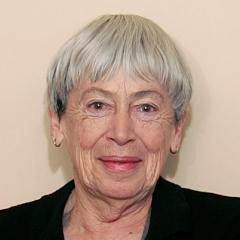
Ursula K. Le Guin
Ursula K. Le Guin

Ursula K. Le Guin, born on October 21, 1929, is an esteemed American author of science fiction and fantasy. Known for her profound philosophical insights, rich imagination, and unique narrative style, Le Guin's works have won numerous literary awards and have had a significant impact on science fiction and fantasy literature. Her most famous works include the 'Earthsea' series and 'The Left Hand of Darkness', which have won her awards such as the Nebula and Hugo Awards, and she has also received the National Book Award for lifetime achievement for her contributions to literature. more
You May Also Like

“Feyre,' he said- softly enough that I faced him again. 'Why?' He tilted his head to the side. 'You dislike our kind on a good day. And after Andras...' Even in the darkened hallway, his usually bright eyes were shadowed. 'So why?' I took a step closer to him, my blood-covered feet sticking to the rug. I glanced down the stairs to where I could still see the prone form of the faerie and the stumps of his wings. 'Because I wouldn't want to die alone,' I said, and my voice wobbled as I looked at Tamlin again, forcing myself to meet his stare. 'Because I'd want someone to hold my hand until the end, and awhile after that. That's something everyone deserves, human or faerie.' I swallowed hard, my throat painfully tight. 'I regret what I did to Andras,' I said, the words so strangled they were no more than a whisper. 'I regret that there was... such hate in my heart. I wish I could undo it- and... I'm sorry. So very sorry.' I couldn't remember the last time- if ever- I'd spoken to anyone like that. But he just nodded and turned away, and I wondered if I should say more, if I should kneel and beg for his forgiveness. If he felt such grief, such guilt, over a stranger, than Andras... By the time I opened my mouth, he was already down the steps. I watched him- watched every movement he made, the muscles of his body visible through that blood-soaked tunic, watched that invisible weight bearing down on his shoulders. He didn't look at me as he scooped up the broken body and carried it to the garden doors beyond my line of sight. I went to the window at the top of the stairs, watching as Tamlin carried the faerie through the moonlit garden and into the rolling fields beyond. He never once glanced back.”

“A strangled, sobbing gasp choked Wendy as the world started to spin around her. She tried to breathe, to break through whatever hold this memory still had on her, but it was all she could do not to let herself go completely. Every piece of her was trapped in that day, silently screaming for her younger self not to abandon her mother in her last moments.”

“I'm outside my parents' home in the aftermath of their deaths, waiting for my three siblings to arrive so we can go through it, room by room, object by object, memory by memory; decide what to keep, what to discard. Stepping out of my rental car, part of me feels like a trespasser now, while another part feels like I never left. (7)”

“In addition to the physical aspects of the work, I'm here to recreate my own personal story, my own narrative. For years—a lifetime, really—when I thought about my life, I saw it through the lens of other people, usually my parents, sometimes my sib-lings. If they told me I was this, that, or the other type of person, I usually took their words at face value, even when the descriptions sounded negative, even when I fought their pronouncements. But translation is all about making decisions, hundreds, even thousands of decisions. Maybe a new way exists to look at myself, at my life. At long last, I’ll take those same words and events to come up with different meanings, different interpretations, ones I've reached on my own, stripping away others' interpretations of who I am. (9)”