Quotessence
Home / Quotes / Quote by Anita Loos

Quote by Anita Loos

“December 1931 was drawing to a close and Hollywood was aglow with Christmas spirit, undaunted by sizzling sunshine, palm trees, and the dry encircling hills that would never feel the kiss of snow. But the “Know-how” that would transform the Chaplin studio in the frozen Chilkoot Pass could easily achieve a white Christmas. In Wilson’s Rolls-Royce convertible, we drove past Christmas trees heavy with fake snow. An entire estate on Fairfax Avenue had been draped in cotton batting; carolers straight out of Dickens were at its gate, perspiring under mufflers and greatcoats. The street signs on Hollywood Boulevard had been changed to Santa Claus Lane. They drooped with heavy glass icicles. A parade was led by a band blaring out “Santa Claus is Coming to Town,” followed by Santa driving a sleigh. But Hollywood granted Santa the extra dimension of a Sweetheart and seated beside him was Clara Bow (or was it Mabel Normand?)”

Quote by Anita Loos

Work

Kiss Hollywood good-by

This book delves into the personal journey of an actress who decides to step away from the glitz and glamour of Hollywood to pursue a more tranquil existence. The narrative follows her transition from the high-profile entertainment industry to a new, uncharted life, offering insights into the complexities of fame, personal growth, and the pursuit of genuine happiness. more

Author
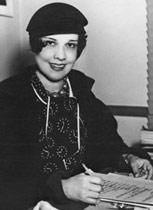
Anita Loos
Anita Loos

Anita Loos was an American screenwriter renowned for her sharp wit and satirical style. She is most famous for her work on the film 'Gentlemen Prefer Blondes'. Born on April 26, 1889, in Los Angeles, California, she passed away on August 18, 1981. more

You May Also Like

“Almost immediately after jazz musicians arrived in Paris, they began to gather in two of the city’s most important creative neighborhoods: Montmartre and Montparnasse, respectively the Right and Left Bank haunts of artists, intellectuals, poets, and musicians since the late nineteenth century. Performing in these high-profile and popular entertainment districts could give an advantage to jazz musicians because Parisians and tourists already knew to go there when they wanted to spend a night out on the town. As hubs of artistic imagination and experimentation, Montmartre and Montparnasse therefore attracted the kinds of audiences that might appreciate the new and thrilling sounds of jazz. For many listeners, these locations leant the music something of their own exciting aura, and the early success of jazz in Paris probably had at least as much to do with musicians playing there as did other factors. In spite of their similarities, however, by the 1920s these neighborhoods were on two very different paths, each representing competing visions of what France could become after the war. And the reactions to jazz in each place became important markers of the difference between the two areas and visions. Montmartre was legendary as the late-nineteenth-century capital of “bohemian Paris,” where French artists had gathered and cabaret songs had filled the air. In its heyday, Montmartre was one of the centers of popular entertainment, and its artists prided themselves on flying in the face of respectable middle-class values. But by the 1920s, Montmartre represented an established artistic tradition, not the challenge to bourgeois life that it had been at the fin de siècle. Entertainment culture was rapidly changing both in substance and style in the postwar era, and a desire for new sounds, including foreign music and exotic art, was quickly replacing the love for the cabarets’ French chansons. Jazz was not entirely to blame for such changes, of course. Commercial pressures, especially the rapidly growing tourist trade, eroded the popularity of old Montmartre cabarets, which were not always able to compete with the newer music halls and dance halls. Yet jazz bore much of the criticism from those who saw the changes in Montmartre as the death of French popular entertainment. Montparnasse, on the other hand, was the face of a modern Paris. It was the international crossroads where an ever changing mixture of people celebrated, rather than lamented, cosmopolitanism and exoticism in all its forms, especially in jazz bands. These different attitudes within the entertainment districts and their institutions reflected the impact of the broader trends at work in Paris—the influx of foreign populations, for example, or the advent of cars and electricity on city streets as indicators of modern technology—and the possible consequences for French culture. Jazz was at the confluence of these trends, and it became a convenient symbol for the struggle they represented.”

“When he was sixteen (1923), Peter got a job as copy boy on a New York tabloid and entered a saltier, more hard-bitten world. It was a roaring, lush, lousy tabloid. Everybody was drunk all the time. The managing editor hired girl reporters on condition they sleep with him. New staffs moved in and were mowed down like the Light Brigade. Chorus girls, debutantes, and widows suspected of murdering their husbands were perched on desks with their thighs showing to be photographed. An endless parade of cranks, freaks, ministers, actresses, and politicians moved through the big babbling room, day and night. The city editor went crazy one afternoon. So did his successor. And among the typewriters and the paste pots and the thighs, Peter walked with simple delight. A young reporter took a liking to him, found he was homeless, and insisted he share an elegant bachelor apartment uptown. There were constant parties, starting at dawn and ending as the hush of twilight settled over the city. People went to work and went to parties until they got the two pursuits confused and never noticed the difference. Whisky was oxygen, women were furniture, thinking was masochism.”

“Momma was with the pony last night. Lily and me have him in the mornings, and we give him a wash with the shammy cloths and a soapy bucket so he's ready for Jade to look after him the next night. I think Momma must ride him too rough because he's always sweating and white-eyed when we get him, pulling tight at his rope and spreading his wide beige lips. He won't settle forever and ever, he just turns circles around the stake. Me and Lily get nervy watching him paw scoops out of the backyard soil.”

“The picnic table in the photo was an old door set up on sawhorses, and the seats were old tree stumps, or maybe thick pieces of firewood, topped with square cushions. Six men were sitting there, not looking at the camera, but at the beautiful woman with long, dark hair, almost to her waist, standing at the head of the table. She was smiling, her arms outstretched, as if welcoming everyone to her world. The apple tree in the background, just barely visible, was stretching a single limb out to her, as if wanting to be in the photo with her. Even it looked a little in love with her.”