Quotessence
Home / Quotes / Quote by Thomas Paine

Quote by Thomas Paine

“I do not believe in the creed professed by the Jewish church, by the Roman church, by the Greek church, by the Turkish church, by the Protestant church, nor by any church that I know of. My own mind is my own church. All national institutions of churches, whether Jewish, Christian, or Turkish, appear to me no other than human inventions set up to terrify and enslave mankind, and monopolize power and profit.”

Quote by Thomas Paine

Work

The age of reason

Pensado by Thomas Paine, this seminal text delves into the author's beliefs regarding the role of reason in understanding the world and its implications for religion and governance. It is a critical examination of the supernatural and the divine, advocating for a rational approach to understanding the universe. more

Author

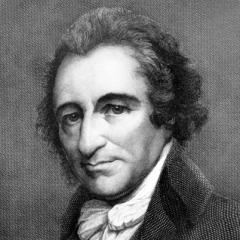
Thomas Paine
Thomas Paine

Thomas Paine, born on February 9, 1737, and died on June 8, 1809, was a prominent American writer, political figure, and philosopher during the American Revolutionary War. He is renowned for his radical democratic ideas and his contributions to the American independence movement. more

You May Also Like

“Romanticism embodied "a new and restless spirit, seeking violently to burst through old and cramping forms, a nervous preoccupation with perpetually changing inner states of consciousness, a longing for the unbounded and the indefinable, for perpetual movement and change, an effort to return to the forgotten sources of life, a passionate effort at self-assertion both individual and collective, a search after means of expressing an unappeasable yearning for unattainable goals.”

“He remembered a version of himself untrammeled by expectation, unimpeded by Ego. He had suffered in the many years since then, seeking to return to that original self, if, in fact, it ever existed. And yet, he was helpless but to regard that unmistakable fear that gripped him in his dream as a sign that his unevenness lent him now to utter incongruity with this specter of past.”

“Poets claim that we recapture for a moment the self that we were long ago when we enter some house or garden in which we used to live in our youth. But these are most hazardous pilgrimages, which end as often in disappointment as in success. It is in ourselves that we should rather seek to find those fixed places, contemporaneous with different years. And great fatigue followed by a good night's rest can to a certain extent help us to do so. For in order to make us descend into the most subterranean galleries of sleep, where no reflexion from overnight, no gleam of memory comes to light up the interior monologue—if the latter does not itself cease—fatigue followed by rest will so thoroughly turn over the soil and penetrate the bedrock of our bodies that we discover down there, where our muscles plunge and twist in their ramifications and breathe in new life, the garden where we played in our childhood. There is no need to travel in order to see it again; we must dig down inwardly to discover it. What once covered the earth is no longer above but beneath it; a mere excursion does not suffice for a visit to the dead city: excavation is necessary also. But we shall see how certain fugitive and fortuitous impressions carry us back even more effectively to the past, with a more delicate precision, with a more light-winged, more immaterial, more headlong, more unerring, more immortal flight, than these organic dislocations.”

“Recalling, some time later, what I had felt at the time, I distinguished the impression of having been held for a moment in her mouth, myself, naked, without any of the social attributes which belonged equally to her other playmates and, when she used my surname, to my parents, accessories of which her lips - by the effort she made, a little after her father's manner, to articulate the words to which she wished to give a special emphasis - had the air of stripping, of divesting me, like the skin from a fruit of which one can swallow only the pulp, while her glance, adapting itself to the same new degree of intimacy as her speech, fell on me also more directly and testified to the consciousness, the pleasure, even the gratitude that it felt by accompanying itself with a smile.”

“It became a game that I took to with immense gusto: to see how much I could remember about dandelions themselves, or picking wild grapes with my father and brother, rediscovering the mosquito-breeding ground rain barrel by the side bay window, or searching out the smell of the gold-fuzzed bees that hung around our back porch grape arbor. Bees do have a smell, you know, and if they don't they should, for their feet are dusted with spices from a million flowers.”

“The capitalist and consumerist ethics are two sides of the same coin, a merger of two commandments. The supreme commandment of the rich is ‘Invest!’ The supreme commandment of the rest of us is ‘Buy!’ The capitalist–consumerist ethic is revolutionary in another respect. Most previous ethical systems presented people with a pretty tough deal. They were promised paradise, but only if they cultivated compassion and tolerance, overcame craving and anger, and restrained their selfish interests. This was too tough for most. The history of ethics is a sad tale of wonderful ideals that nobody can live up to. Most Christians did not imitate Christ, most Buddhists failed to follow Buddha, and most Confucians would have caused Confucius a temper tantrum. In contrast, most people today successfully live up to the capitalist–consumerist ideal. The new ethic promises paradise on condition that the rich remain greedy and spend their time making more money and that the masses give free reign to their cravings and passions and buy more and more. This is the first religion in history whose followers actually do what they are asked to do. How though do we know that we'll really get paradise in return? We've seen it on television.”