Quotessence
Home / Quotes / Quote by Joseph Stalin

Quote by Joseph Stalin

Author

Joseph Stalin
Joseph Stalin

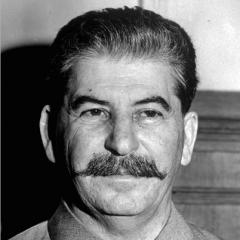
Joseph Stalin, the former Premier of the Soviet Union, was born on December 18, 1878, and died on March 5, 1953. He was the leader of the Soviet Communist Party and had a profound impact on the political, economic, and military development of the Soviet Union. more

You May Also Like

“'A fine story', said Asterinov .... 'Six months in prison, that tale,' said Sergei. 'Was it the witch?', I asked 'I never know where the Party stands on issues of the supernatural...' ..... 'It was, - understand, I do not know for sure, I heard this at second or third hand - it was the walk through the forest. Apparently I was just too convincing in the representation of a poor man's yearning for money...'”

“Я пытался писать обыкновенный роман по методу социалистического реализма — единственному, который я знал, которому учили со школьной парты и далее всю жизнь. Но правда жизни, превращаясь в «правду художественную», почему-то на глазах тускнела, становилась банальной, гладенькой, лживой и, наконец, подлой. Социалистический реализм обязывает писать не столько так, как было, сколько так, как это должно было быть, или, во всяком случае, могло быть. Ложный и лицемерный этот и метод, собственно, и загубил великую в прошлом русскую литературу. Я отказываюсь от него навсегда [11—12].”

“There is no concept of justice in Cree culture. The nearest word is kintohpatatin, which loosely translates to "you've been listened to." But kintohpatatin is richer than justice - really it means you've been listened to by someone compassionate and fair, and your needs will be taken seriously.”

“When I left residential school, I became confused and saw life from a different perspective. I was not aware of society. I was now living in the world, seeing people other than priests and nuns. I was ashamed of who I was. After nine years of having negative messages drilled into my head at residential school, my mind was tattered by the time I was released. I had been taught that to be Native meant I had no value: that I was not human. I felt defective and did not know how to change this. I was overflowing with shame. When my relatives staggered down the streets, I would pretend I did not know them. I felt embarrassed seeing them drunk. When people saw them staggering down the street, they were not just calling them down, they were also including me. I took this so personally. I often wondered why they were like this. I did not realize they had the same pain I had, maybe more, and that was their way of coping.”

“I do not think I was capable of understanding, as I was only six. My mother became distant and shut her feelings as she left me. How could she explain to me—a six-year-old—what was going to happen to me? This was a hopeless situation for both of us. A mother giving up her child to strangers is one of the hardest things to do, and I would soon know what alone meant.”