Quotessence
Home / Quotes / Quote by Samuel Beckett

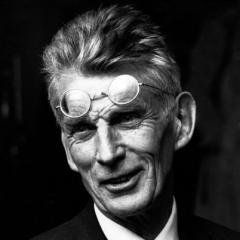
Quote by Samuel Beckett

Work

Molloy

Molloy is a work of postmodern literature known for its stream-of-consciousness style and its exploration of themes such as identity, language, and the absurd. The story follows the title character, Molloy, as he grapples with the meaning of existence and his own place in the world. more

Author

Samuel Beckett
Samuel Beckett

Samuel Beckett was an Irish novelist, playwright, and poet, widely regarded as one of the most influential writers of the 20th century. His works are characterized by their minimalist style, existential themes, and use of language. His most famous works include 'Waiting for Godot' and 'Molloy'. Beckett was awarded the Nobel Prize in Literature in 1969. more

You May Also Like

“He ran away a lot after that, still trying to find something exciting to make life less dull. His parents always said he was never satisfied, and would never be satisfied even if he found what he was looking for. Duncan hoped that wasn't true, but he wasn't sure. Taylor walked alongside Duncan, stepping on all of the fallen autumn leaves, and Duncan was sure it was a new song creating itself. That's how Taylor was. He heard music in the wind and in the crunch of leaves and new songs were growing out of his ears and Duncan was lost. That was it, he realized. Lost.”

“The "Monalisa Lisa" is an optical illusion created by Leonardo Da Vinci. The woman in the painting "The Mona Lisa" doesn't appear to be always smiling. When you look at the mouth you feel she looks sad, melancholic, and hostile. But when you look at the eyes you feel she is happy and cheerful. Leonardo perfected the "sfumato technique," which translated literally from Italian means "vanished or evaporated." He created imperceptible transitions between light and shade, and sometimes between colors. "Why the Silhouette?" appears as a simple story of a few individuals, but when you look at it from a distance, it appears to show you the philosophy of life. I have tried to create imperceptible transitions between light and darkness and sometimes between colors. Hope you see the illusion in "Why the Silhouette?”

“They needed each other that in that moment. Two children cast in dire straits—opposite, yet so similar. Deep tragedy, near-complete amnesia, feelings of worthlessness, loneliness, and hatred eating both to the core, with no one on their side. In that moment, they discovered that they weren’t alone. That there was still hope. Still a chance for forgiveness.”