Quotessence
Home / Quotes / Quote by Swami Vivekananda

Quote by Swami Vivekananda

“The only religion that ought to be taught is the religion of fearlessness. ... it is true that fear is the sure cause of degradation and sin. It is fear that brings misery, fear that brings death, fear that breeds evil. And what causes fear? - Ignorance of our own nature.”

Quote by Swami Vivekananda

Author
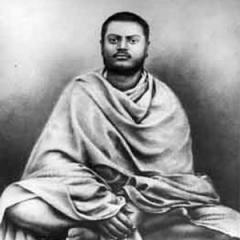
Swami Vivekananda
Swami Vivekananda

Swami Vivekananda (January 12, 1863 – July 4, 1902) was an Indian Hindu monk, philosopher, and social reformer. Born as Narendranath Datta in Kolkata, he was a chief disciple of the mystic Ramakrishna. He is best known for his historic speech at the 1893 Parliament of the World's Religions in Chicago, where he introduced Hinduism to the Western world. He founded the Ramakrishna Mission in 1897, focusing on social service, education, and interfaith harmony. His teachings emphasized self-realization, service to humanity, and the unity of all religions. He wrote extensively on yoga and Vedanta philosophy, influencing global spirituality and Indian nationalism. He died at the age of 39, leaving a lasting legacy as a bridge between Eastern and Western thought. more

You May Also Like

“We have to condemn publicly the very idea that some people have the right to repress others. In keeping silent about evil, in burying it so deep within us that no sign of it appears on the surface, we are implanting it, and it will rise up a thousandfold in the future. When we neither punish nor reproach evildoers, we are not simply protecting their trivial old age, we are thereby ripping the foundations of justice from beneath new generations. It is for this reason, and not because of the “weakness of indoctrinational work,” that they are growing up “indifferent.” Young people are acquiring the conviction that foul deeds are never punished on earth, that they always bring prosperity. It is going to be uncomfortable, horrible, to live in such a country!”

“Most of us may intuitively agree about right and wrong, but we also, and far more significantly, differ enormously in the ways in which we rank the virtues and the vices. ... To put cruelty first is to disregard the idea of sin as it is understood by revealed religion. Sins are transgressions of a divine rule and offenses against God; pride - the rejection of God - must always be the worst one, which gives rise to all the others. However, cruelty - the willful inflicting of physical pain on a weaker being in order to cause anguish and fear - is a wrong done entirely to another creature. When it is marked as the supreme evil it is judged so in and of itself, and not because it signifies a denial of God or any other higher norm. It is a judgment made from within the world in which cruelty occurs as part of our normal private life and our daily public practices. By putting it unconditionally first, with nothing above us to excuse or to forgive acts of cruelty, one closes off any appeal to any order other than that of actuality. To hate cruelty with utmost intensity is perfectly compatible with Biblical religiosity, but to put it first does place one irrevocably outside the sphere of revealed religion. For it is a purely human verdict upon human conduct, and so puts religion at a certain distance. The decision to put cruelty first is not, however, prompted merely by religious skepticism. It emerges, rather, from the recognition that the habits of the faithful do not differ from those of the faithless in their brutalities, and that Machiavelli had triumphed before he had ever written a line. To put cruelty first therefore is to be at odds not only with religion but with normal politics as well.”

“...all that can, all that need be urged, in the form of expostulation, entreaty, rebuke, against that crime of crimes,--making man the property of his fellow-man! O, how accursed is that system, which entombs the godlike mind of man, defaces the divine image, reduces those who by creation were crowned with glory and honor to a level with four-footed beasts, and exalts the dealer in human flesh above all that is called God! Why should its existence be prolonged one hour? Is it not evil, only evil, and that continually? What does its presence imply but the absence of all fear of God, all regard for man, on the part of the people of the United States? Heaven speed its eternal overthrow!”

“Whether it be because the Fall has really brought men nearer to less desirable neighbours in the spiritual world, or whether it is merely that the mood of men eager or greedy finds it easier to imagine evil, I believe that the black magic of witchcraft has been much more practical and much less poetical than the white magic of mythology. I fancy the garden of the witch has been kept much more carefully than the woodland of the nymph. I fancy the evil field has even been more fruitful than the good. To start with, some impulse, perhaps a sort of desperate impulse, drove men to the darker powers when dealing with practical problems. There was a sort of secret and perverse feeling that the darker powers would really do things; that they had no nonsense about them. And indeed that popular phase exactly expresses the point. The gods of mere mythology had a great deal of nonsense about them. They had a great deal of good nonsense about them; in the happy and hilarious sense in which we talk of the nonsense of Jabberwocky or the Land where Jumblies live. But the man consulting a demon felt as many a man has felt in consulting a detective, especially a private detective; that it was dirty work but the work would really be done. A man did not exactly go into the wood to meet a nymph; he rather went with the hope of meeting a nymph. It was an adventure rather than an assignation. But the devil really kept his appointments and even in one sense kept his promises; even if a man sometimes wished afterwards, like Macbeth, that he had broken them.”