Quotessence
Home / Quotes / Quote by Karl Marx

Quote by Karl Marx

“History is not like some individual person, which uses men to achieve its ends. History is nothing but the actions of men in pursuit of their ends.”

Quote by Karl Marx

Author
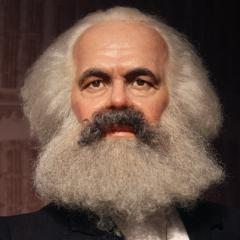
Karl Marx
Karl Marx

Karl Marx (May 5, 1818 - March 14, 1883) was a German philosopher, economist, sociologist, political theorist, and revolutionary. He is one of the founders of Marxism and his works, including 'Das Kapital' and 'The Communist Manifesto', have had a profound impact on the world. more

You May Also Like

“You never want to limit your potential satisfaction, growth, and long-term happiness by always having to focus on the negativity from others from your past.”

“Bakunin, on the other hand, considered himself a revolutionist of the deed, "not a philosopher and not an inventor of systems, like Marx." He adamantly refused to recognize the existence of any "a priori ideas or preordained, preconceived laws." Bakunin rejected the view that social change depended on the gradual maturation of "objective" historical conditions. On the contrary, he believed that men shaped their own destinies, that their lives could not be squeezed into a Procrustean bed of abstract sociological formulas. "No theory, no ready-made system, no book that has ever been written will save the world," Bakunin declared. "I cleave to no system, I am a true seeker." Mankind was not compelled to wait patiently as the fabric of history unfolded in the fullness of time. By teaching the working masses theories, Marx would only succeed in stifling the revolutionary ardor every man already possessed—"the impulse to liberty, the passion for equality, the holy instinct of revolt.”

“...in pure mathematics the mind deal only with its own creations and imaginations. The concepts of number and form have not been derived from any source other than the world of reality. The ten fingers on which men learned to count, that is, to carry out the first arithmetical operation, may be anything else, but they are certainly not only objects that can be counted, but also the ability to exclude all properties of the objects considered other than their number-and this ability is the product of a long historical evolution based on experience. Like the idea of number, so the idea of form is derived exclusively from the external world, and does not arise in the mind as a product of pure thought.”

“In the second place, however, history is made in such a way that the final result always arises from conflicts between many individual wills, of which each in turn has been made what it is by a host of particular conditions of life. Thus there are innumerable intersecting forces, an infinite series of parallelograms of forces which give rise to one resultant — the historical event. This may again itself be viewed as the product of a power which works as a whole unconsciously and without volition. For what each individual wills is obstructed by everyone else, and what emerges is something that no one willed. Thus history has proceeded hitherto in the manner of a natural process and is essentially subject to the same laws of motion. But from the fact that the wills of individuals — each of whom desires what he is impelled to by his physical constitution and external, in the last resort economic, circumstances (either his own personal circumstances or those of society in general) — do not attain what they want, but are merged into an aggregate mean, a common resultant, it must not be concluded that they are equal to zero. On the contrary, each contributes to the resultant and is to this extent included in it.”

“The separation between the Man of Labour and the Instruments of Labout once established, such a state of things will maintain itself and reproduce itself upon a constantly increasing scale, until a new and fundamental revolution in the mode of production should again overturn it, and restore the original union in a new historical form.”

“In nineteenth century Europe (and later in other parts of the world) the transition from a subsistence to a market economy based on the use of wage labor caused a net loss of autonomy for kin-based groups and households. Individuals became more dependent on external political, economic, and ideological forces. A profound contradiction resulted from the increasing individuation of the labor force and the need to maintain collective mechanisms for the reproduction of the working class through preexisting but constantly evolving patterns of family, household, and kinship organization. In other words, the advance of capitalism created a dynamic opposition between productive and reproductive spheres.”